
Keyword Intelligence by Ron Jones
The site has been running for 3 months. We are starting to get some inquiries, but for from enough. Keyword Research is one of my top priorities. This is the only book in my library that address this.
Glossary
PPC: Pay-per-click
The basis of the PPC program is that you bid on the keywords for which you want your ads to show upon the keywords that will trigger your ad. This required a better understanding of the right keywords to buy or to bid for…
Ads, which the search engines place in and around the search results, are the other type of links.
SEO: search engine optimization
Organic listings are the “free” listings that the search engines present as the most relevant sites it believes match the users’ search query.
SEM: Search Engine Marketing
Keyword: Search queries
SERP: search engine results pages
CTR: Click-through-rate
CPC: Cost per click
CVR: Conversion Rates
CPA: Cost per acquisition
KR: Keyword Research
KD: Keyword Difficulty
KW: Keyword
GA: Google Analytics
Resources, links and tools
Jessica Bowman @ SEOinhouse.com: An SEO training and consulting company.
Google AdWords Keyword Tool: Find out what keywords are not being used and add them to your keyword list.
Keyword Discovery (www.keyworddiscovery.com): Find out what keywords are not being used and add them to your keyword list.
Word tracker (www.wordtracker.com): Find out what keywords are not being used and add them to your keyword list.
Wordstream (www.wordstream.com): Find out what keywords are not being used and add them to your keyword list.
iSpionage (www.ispionage.com): provide information on an organization’s PPC and SEO efforts.
KeywordSpy (www.keywordspy.com) is similar to the others and helps you keep track of the most highly searched keywords.
Compete (www.compete.com) and Quantcast (www.quantcast.com). Both of these tools go beyond finding your competition’s keywords. They provide insight into your competitors’ site traffic and demographic data.
Trellian’s Keyword Discovery tool (http://keyworddiscovery.com): general-use, all-around keyword tools.
WordStream: https://www.wordstream.com/free-keyword-tools
Wordtracker: https://www.wordtracker.com/
Alibaba 后台选词参谋+市场参谋+产品参谋(Cross reference w/ other tools)
Chapter 1 History and background
Pointes of interests:
Keyworddefinition: A word or phrase that represents a larger concept or idea.
The reason we fail to find what we are looking for usually stems from the search query we came up with and the keyword phrase the content developer uses.
- First search engine: Archie.
Keywords are the gatekeepers of information. You just need to know the right password to get in.
An interesting point of view, I never thought keywords this way.
The idea of gaining higher rank… drive increased traffic. This insight… marked the beginning of search engine optimization (SEO) as an industry. One of the key fundamentals of SEO is keyword research.
“An insight drove an industry.” This is another interesting perceptive. My insight derived from his. Interesting how evolution taken place, deriving new from the old.
Keywords and Keyword research are vital for success for:
- Online searching begins with a query: A keyword represent what you are looking for, also important when managing search expectations.
- KR is strategic: The foundation is a list of tested, verified keywords, organized to complement marketing channels. Without a strategy, will become lost in depths of random pages without a focus.
- Foundation for all marketing campaigns: Keyword Research is part of a branding campaign. Use keywords to craft positioning statements or product and service descriptions.
- Online campaigns:
- SEO
- PPC
- Social Media: use the right keywords in your conversations with blogs, Facebook, Twitter, and other social media sites.
- Local / Mobile: Local and mobile search companies need to have their listings filled out properly using keywords that are at the core of what they do.
- Video and image search: Videos and images need to be tagged with the right keywords in their descriptions.
- Display and banner
- Real-time search
- Offline campaigns:
- Print: Press, news, TV commercials, now all go online as well. Publications being digitized.
- TV
- Radio: Speech-to-text help convert speech to text and index, then go online.
- Public Relations(PR)
- Branding and Positioning
- Direct Marketing
- Billboard
- Online campaigns:
- Offline marketing
- Insufficiency leads to waste of time and money
Keyword research is a core function for all online marketing initiatives.
Many marketers are turning to social media to help them with reputation management.
Having a unified keyword strategy improves your likelihood of ranking well with search engines by focusing all of your online content intently on your most important keywords.
Essentially, you are not only influencing the way people think about your brand but also the search queries they will use to find you on the Internet.
How wrong keywords are costly:
- Mundane and tedious, time-consuming and hard to automate.
- Low conversion means wrong traffic.
- Contains more implicit challenges, and it takes much resource to just realize those problems, KR needs to happen ahead of any campaign.
- SET UP A SITE ANALYTIC, so you can analyze the core keywords, types of traffic…
Suffice it to say that embarking on any online marketing campaign without having a solid keyword research study will come back to haunt you. Make sure you take the time to get this done correctly, and test and validate your list to ensure that you have identified the right keywords for your campaigns.
6 principles of Keyword Research
1. The secret formula
The Right Keywords + Relevant Destination Content = Conversions
The Right Keywords + Relevant Destination Content = Conversions
The Right Keywords + Relevant Destination Content = Conversions
By identifying the right keywords and then connecting them to relevant destination content, you will achieve a higher conversion rate.
2. Keyword Relevance
A skeleton of keyword campaign:
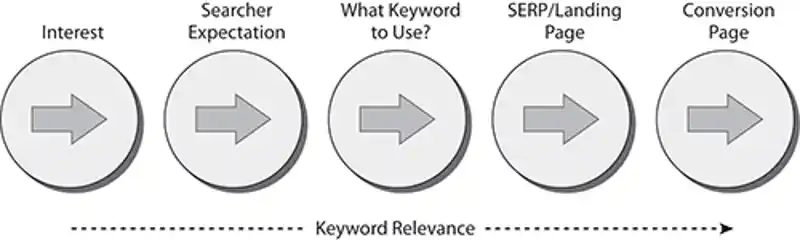
Conversion: be it contact form, final shopping cart, or download page….
if the keywords that have been researched can then be shared with those who are driving the messaging, there can be another great benefit. If the core keywords can be embedded into the messages from the beginning, then they can actually influence the keywords that are chosen to be used in a search query. This is powerful. For those that are trying to condense their expectation into keywords, it is possible to help them with messaging that includes your targeted keywords. So don’t underestimate the power of other channels to influence your target audience.
3. Keywords and the Buying Cycle
You should find this information(buying cycle) or begin the process of conducting this research within your company.
If I choose keywords that are general or broad, I am likely to attract visitors who are not ready to convert, who are just looking for information. If I chose more specific keywords, then I am likely to attract an audience who is ready to convert. Which audience would you rather have? I am not saying that attracting a broad audience is bad, but you need to have a different expectation from that group. You need to treat them differently. Teach them what to look for in a bike, for instance, and be a good resource for them as they collect their needed information. Then, if they have a good experience, they might return and buy from you.
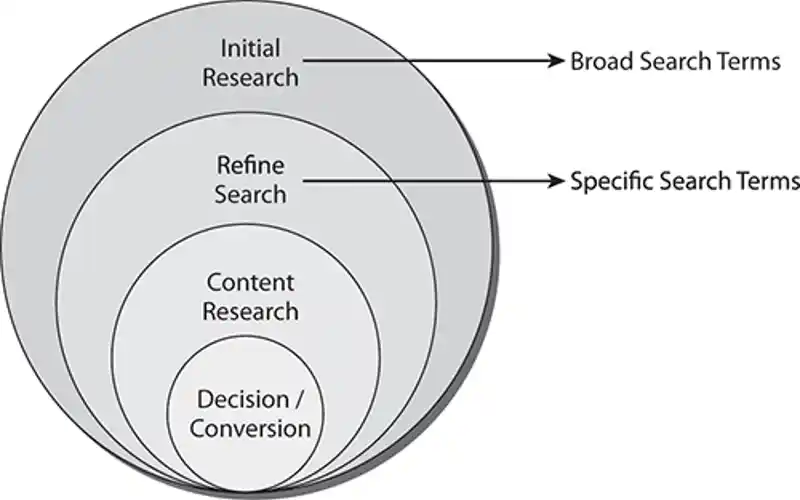
4. Broad Keywords vs. Specific Keywords
Broad Keywords: General, Popular, More often - Give you more impressions. Ramp up the PPC costs, lower conversion rates.
Specific Keywords: Give you more CTRs as well as conversion rates, but not as many impressions as Broad Keywords.
Basically, broad keywords and specific keywords determines two directions of PPC campaign: Branding oriented v.s. conversion oriented.
The strategic decision you need to make is whether to make your campaign more branding oriented or more conversion oriented. If you are out to gain impressions and that is the success metric you are focusing on, then broad keywords will work best for you. On the other hand, if you are looking for searchers to become customers, specific keywords should be in your strategy… You at least need to be able to see the dynamics between the two and plan accordingly.
| Strategy | Tactic |
|---|---|
| Branding strategy | Broad keywords |
| Conversion strategy | Specific keywords |
| Hybrid strategy | Broad and specific keywords |
5. The Long Tail
Another thing that is related to broad and specific keywords is the long tail. The term long tail was popularized by Chris Anderson of WIRED magazine who later wrote a book on the topic. The example he used was how Amazon generates most of its revenue from a large number of specialized titles, not necessarily the big, high-selling blockbusters you come across in bookstores. The idea is that each specialized title may only sell small quantities per year, but there are enormous amounts of them.
Point of interest: Chris Anderson
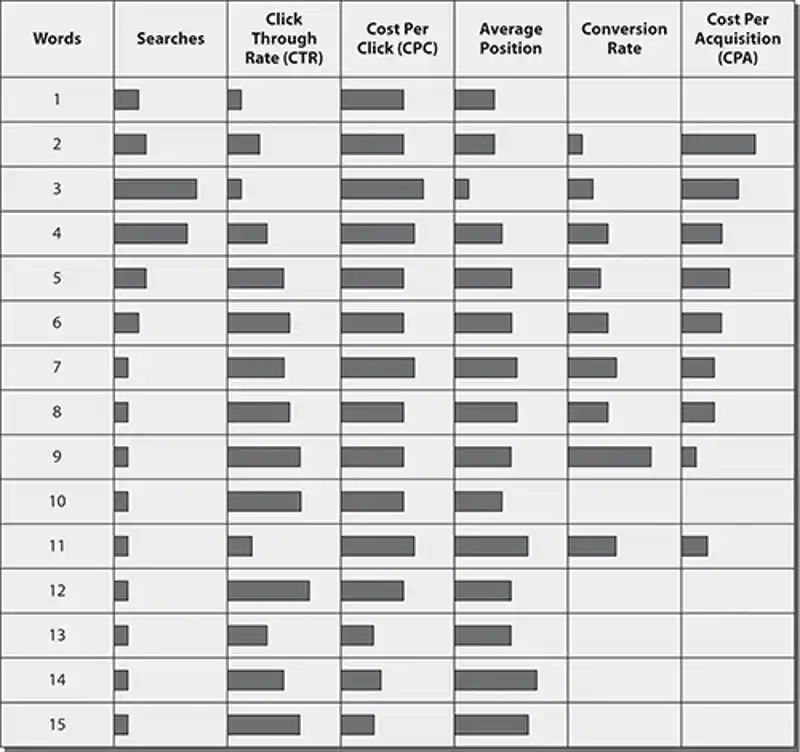
6. Keyword Interpretation
So it is important to pay close attention to actual traffic and the sales you gain from your keywords and not just your ranking in search engines. You will often be surprised at which keywords are really performing and which are not.
What can you do to get them to convert? Or do you need to eliminate that keyword from your campaign and target a different set of visitors who will convert?
So using PPC to test your keywords and learn about how they perform is a great way to study your target audience and learn their behavior.
- Learn target audience
- How they reach your site
- Commonly used phrases
- Check your understanding of your target audience
- Other
- Observe which keywords are performing for SEO and PPC
- Rank in 1 SERP
- Measure traffic
- Test to see which work and which do not
- Get ideas for new content, services or products
Chapter 2 How to develop a keyword strategy
KR is part of a marketing campaign. So, to integrate it, you will need a marketing campaign first.
A brief skeleton of a marketing plan:
- A definition of your business
- A description of your products or services
- A profile of your target audience
- Your company’s role in relation to your competition
- The unique positioning of your company
- Why you are unique and compelling to your customers
- Your pricing strategy
- Your distribution channels
- Your competitive market segments
This strategy document should be used to judge the appropriateness of business actions. If business actions take a course that isn’t outlined, then you should reassess your actions to get back on course. Strategies should be written to be measurable and actionable. This is key. Your strategy sets the criteria in which you will be able to measure success.
Conclusion
Develop Your Marketing Strategy, Plan, and Goals
A strategy outlines your goals, visions. A plan outlines the specific actions to fulfill the strategy.
KR not only part of the marketing strategy/plan, but also ingrained to the minds of all constituents, like a mission statement.
Write the copy and content for each campaign channel.
Keywords: Consistent, Awareness, Relevancy, Conversion
**Decide Marketing Channels **
Goal of Drive-To-Site Campaign: Deliver on target audiences’ expectations. Providing visitors with the information they need and leading them down the path to a conversion.
Goal of Website: Convert visitors to customers.
3 aspects of development process of a site:
- Visual Design
- Technical Design
- Behavioral Design
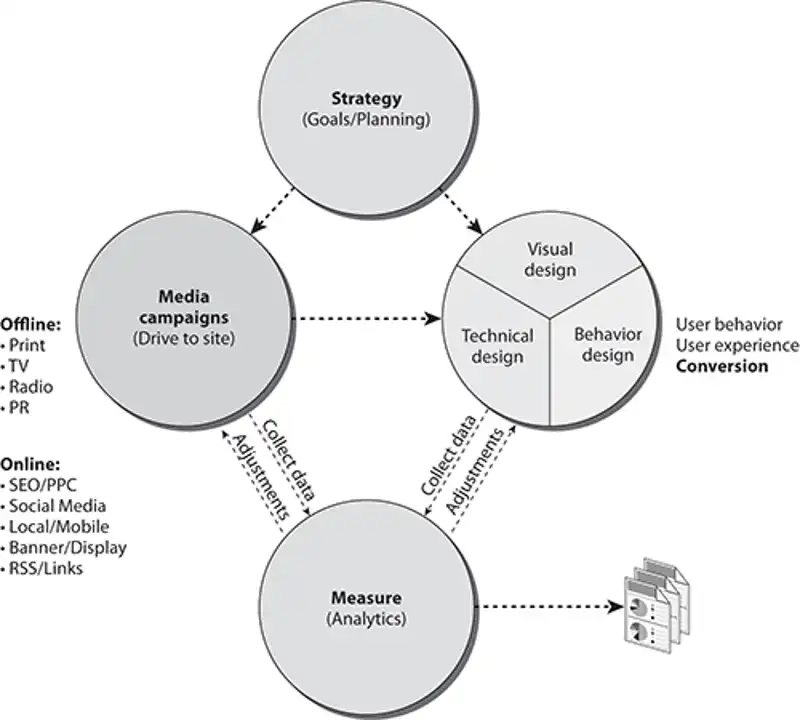
AD, website, store… need to be consistent in visual.
Tech includes server architecture, web apps, databases.
Behavioral is the most important.
Too often a look-and-feel treatment is designed first without any consideration for the audience and its participation on the site. Then when a visual skin is applied to the technical infrastructure, behavioral factors are considered as an afterthought. This is a recipe for failure.
Build visual and technical elements towards customers’ needs.
KR plays a role in Behavioral design by giving you insight to keywords trends and thus construct information structure and content design, helps you anticipate users needs and expectations.
Measure the performance of drive-to-site channels and website.
How to measure success
you have thought ahead of the process and have visualized what success looks like. If you apply what we previously discussed, then you should visualize success in the form of overall business goals.
- Metrics needs to be tied w/ business goals.
Solid understanding of business goals and define metrics for each campaign.
Define success metrics within your marketing plan as a whole, and then define them for each campaign.
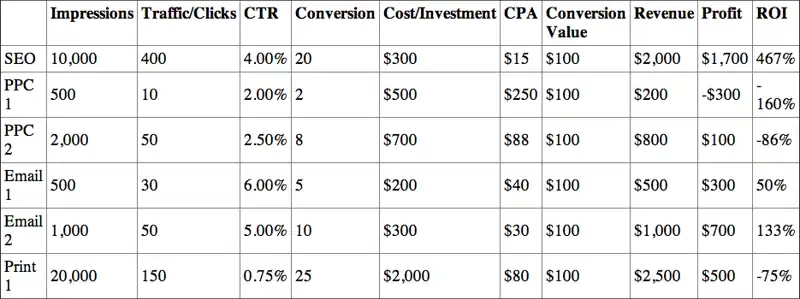
The point here is to help you understand how you can tie all of your marketing campaigns to a single goal, in this case, profit and ROI.
- Divide analytics data into qualitative and quantitative.
Qualitative analysis would seek to answer these questions:
- Are you reaching the right audience?
- Are you providing valuable content?
- Does your brand have a positive sentiment?
Quantitative data would answer these questions:
- How much traffic came from a specific campaign?
- How many followers did we gain?
- What was our click-through rate (CTR)?
Add qualitative analysis to campaigns.
Setting SMART Goals
S = Specific
M = Measurable
A = Attainable
R = Realistic
T = Timely
E.g.: “Increase our average monthly unique visitors to our website from 10,000 to 15,000 within six months with top five targeted keywords.” V.S. “Increase our website traffic this year.” (Specific, Measurable, Timely, 6 months)
E.g.: “Increase our ranking for target keyword from page 6 to page 2 within the next six months” V.S. “Ranked No. 1 in SEO campaign.” (Realistic, Attainable, Timely: 6 months)
Not only have long-term goals, but also short-term milestones.
Benchmarking
Evaluate data with a standard, a reference within a context(industry, competitors, when you first started…)
Benchmarking is a simple concept, but it will help to put your statistics in a clearer context that has more meaning. To gain a little more insight into benchmarking, you might find SEOmoz’s blog post on SEO and social media benchmarking useful: www.seomoz.org/blog/seo-and-social-media-benchmarking.
Team Members and Their Roles and Goals
General challenges that face Internet marketing teams:
- Content: Images, texts, let the content stakeholder be part of the game.
- Clear strategies and goals: Transmit clear goals to all members, make sure messages and direction are right in place.
- Success metrics and methodology: Identify and understanding the real success metrics, build ROI metric model and understood by all.
- Competitive response: Try to see what your competitors are doing and leveraging new marketing efforts while focusing on the inside.
Organization Design
- Matrix Structure:
Goal is to get more of an interdisciplinary collaboration to take place.
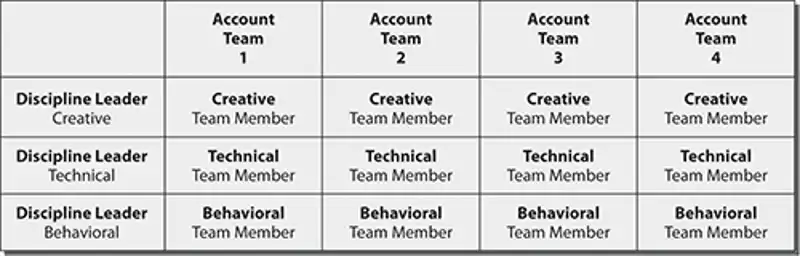
As you can see in Figure 2-2, this structure is organized with members reporting primarily to some kind of director or supervisor on a day-to-day basis. Additionally, each discipline is grouped together and meets regularly to share ideas and innovations. So each column represents accounts, while each row focuses on the discipline. However, the team sits together daily as an account team, which is made up of creative, technical, and behavioral roles, for example. This will also work for other disciplines you might have… still satisfy the need for each team member to work and collaborate with their own discipline.
- Embedded Structure:
Based on Matrix Structure, assign certain members into other divisions and department and they can report to that department. Brings closer relationship.
- Direct Report Structure:
Place a team member within another department and have them report directly to that department.
- Training Structure
Conduct SEO/SEM training for each division and department.
- Outside Vendor Structure
Hire SEM/SEO vendors, having face-to-face meetings, let them know your needs, key takeaways, recommendations… Become more educated and equipped to make wiser marketing decisions. Treat them like a team in your own organization with a partnership, not vendorship.
- Keyword Research Brief
Just as a creative or technical brief outlines general strategy, the keyword research brief would be a one-pager that outlines the targeted keywords that are to be used for marketing purposes and any related, insightful data around these keywords. It would also include the proper use of the keywords in editorial, print, and other content that is developed for the company.
Keyword Competitive Intelligence
Points of interest: SpyFu, Hot Chili Crisp Fly By Jing, KR brief a template.
One simple way to learn more about what keywords your competition is using is to go to any page of their website and view the page source to look at their HTML tags.
You are just looking for the keywords used in the title, meta keyword, and meta description tags. It may not help with SEO… but… what our competition intends to be ranked for.
HTML tags: title, meta name="description", meta name="keywords"
E.g. nationwide.com:
<title>
Nationwide Insurance - Auto Insurance Quotes and Car Insurance Rates
</title>

<meta name="description" content=
"Auto insurance from Nationwide - Save up to $43 every month on car insurance! Get your insurance quote online and start saving today! Learn more about our competitive auto insurance rates - Get a quote online or contact us to speak to an insurance agent."
/>

<meta name="keywords" content=
"car insurance,
auto insurance,
online auto insurance,
auto insurance rates,
car insurance quote"
/>
The keywords I would derive from this are “nationwide insurance”, “auto insurance quotes”, “car insurance”, and even “insurance”. You now have the brand name and two very specific keywords that describe what this web page is all about.
In any case, it is good to include your core keywords in the description as well as the title tag and in other key places… Your core keywords are those that are strategic to your company’s goals like “auto insurance” is for Nationwide.
Keyword Gap Analysis
A keyword gap analysis is analyzing the keywords being used and noting those that should be there but are missing. Find out what keywords are not being used and add them to your keyword list.
Get started with SEO tools.
What Is Your Competition Seeing about You?
Use these tips and tools on your own site to see what you are revealing about yourself.
Keyword Research Process

- Brainstorming: Find All Possible Keywords: Use everything to get as much seed keywords as possible. Use spreadsheet to organize. Rule nothing out, as it will be done in phase two. Tools utilization: Chapter 3: KR Tools, methods: Chapter 4: Finding KWs
- Refine: Identify High-Potential Keywords: Annual searches, Monthly trend, search share among search engines, bidding, competition index. Make sense of the data. Weighted scoring and rank keywords using evaluation criteria. Then determine which set used for which campaign. Evaluate the popularity, competitiveness, broadness/specific, relevancy to business, relevancy to website… Core KWs for SEO, extension KWs for PPC.
- Categorize: Organize into Categories or Audience Segments: Category is all about relevancy. KWs can be used to build web architecture by matching the themed KWs to the corresponding content. Help: Chap 5: 7 Steps to refine KWs. Create more tabs for each category.
- Test: Test and Validate Keyword Performance: Organize test sets, about 5 - 10% of the internet marketing campaign.
It is very important for your visitors and especially for search engines that you have solid, keyword-focused pages that search engines can find, index, and rank you for.
Chapter 3: KR tools
KW and KR Funnel
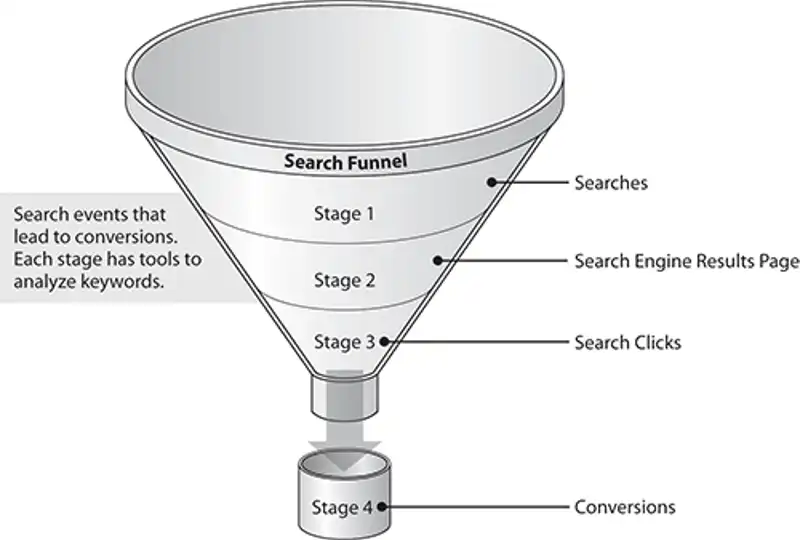
For Searches
Stage 1 Tools, good for seed KWs:
- Google AdWords Keyword Tool
- Microsoft adCenter Advertising Intelligence
- Trellian Keyword Discovery
- WordTracker
- WordStream
- SEOmoz
For SERP
Stage 2 tools for analyzing SERPs:
- AdGooroo(Now Adthena)
- SpyFu
- The Search Monitor
- Conductor
- Covario
- Rank Above
- BrightEdge
- SEOmoz
For CTR
Stage 3 tools for analyzing SERP conversions, CTRs:
- comScore Search Planner
- Hitwise Search Intelligence
- Compete Pro Search Analytics(Ceased operation)
- Trellian Search Term Intelligence Tool
- Alexa(ceased operation)
- AdGooroo, now Adthena
For Conversion
- comScore Search Planner, now proprietary
- Hitwise Search Intelligence, bought by connexity, now proprietary
- Compete Pro Search Analytics(ceased operation)
Pricing Chart
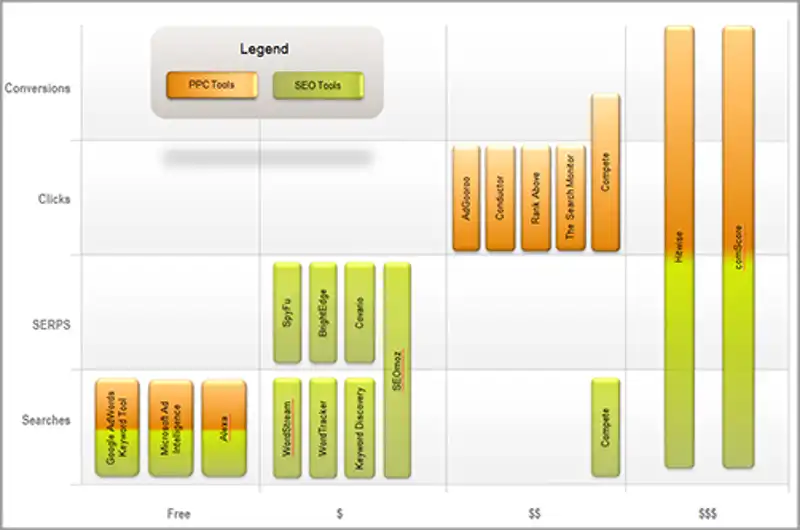
How data are mined
- Search engines (For example, Google collects its own data, contain bot data)
- Search engine APIs (same as above, contain bot data)
- Browser toolbars (Mediocre)
- Purchases from ISPs (Authentic, price goes up)
- Panels of selected participants (Most authentic, but costly)
Why tools report differently
Because of the data sources.
So when you look at your results, you need to look at them in relative terms. Because none of the keyword tools provide perfect numbers, it is important to not take them too literally. Another way to deal with this is to pick the keyword tool of your choice and stick with it as a base.
Scale the results in a proper perspective(1 - 10, weighted) in Chap 5.
Tools for Stage 1 and 2
Trillion’s
Trellian’s Keyword Discovery tool (http://keyworddiscovery.com): General, including data from 200 search engines, data derived from toolbar. Offers free trial, subs start from 50$ a month, 500$ a year.
Pricing and feature Link: https://www.keyworddiscovery.com/keyword-plans.html
UI:
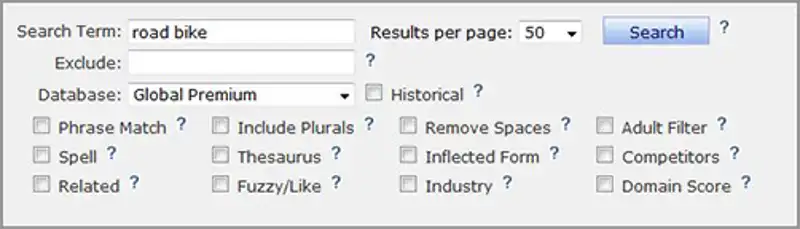
Main function 1: Projects
research your keyword and place it into separate projects. These projects might represent clients, campaigns, or even ad groups. You will find the Project drop-down menu at the top of your browser in the application strip
Databases:
Global Premium: Real Users data collected in toolbars, date back 12 months.
Historical Global: All data from 200 search engines including bots and rankers inflation. Only use it when compare STDEV or relative scaling.
Historical check box: The sum of data of which you choose dated back from Aug 2006. Historical Global Always contains data from all time, anything.

Can select databases corresponding to specific regions.
Question Phrases: As searchers become more savvy about using search engines, they are finding that a straightforward question sometimes gets the best results. So as this trend continues to grow, Keyword Discovery has provided a tool to help visualize which keyword “question” phrases are most popular.
Search term filters: Play around, understand each one. The question marks can help with descriptions.
Add interested KWs to projects. Can navigate the KWs by clicking and gain more insightful data.
Trends: Shows Historical, Monthly, Trend Graph
Market Share: Shows what percent of traffic does each search engine contain.
WordStream
WS’s data derived from multiples sources, including: ISPs, Toolbars, Search Engines, then use algorithms, statistic models, weightings to aggregate the data.
Here are some of the free tools that Wordstream offers:
- Free Keyword tool
- Free Keyword Niche Finder
- Free Keyword Grouper: Auto categorize your KWs in bulk.
- Free Negative Keyword tool: Cancel out undesirable KWs.
- AdWords Performance Grader
Wordtracker
Website: https://www.wordtracker.com/
Data derived from multiple sources, including metacrawlers with real user’s search queries by https://metacrawler.com & https://dogpile.com and ISPs, data can be trusted.
Usage similar to PPC campaigns, supports projects which can be break down into lists. Projects are campaigns, lists are ad groups.
Can choose data sources from Google regional dbs or Wordtracker dbs, WT dbs supports additional filters(Google DB == WT DB’s KW in anyorder filter, broad match).
Search count: then number of times each KW appears in the DB over the past 365 days.
IAAT: In anchor and Title: KW appears in both the title tag of the page and the anchor text of an external link to the page.
KEI & KEI3: refer to WT official web.
The keyword effectiveness index (KEI) is a metric that combines two important other metrics: the number of monthly keyword searches (popularity) and the number of websites (competition) that have that exact keyword in at least one of its incoming hyperlinks, which Wordtracker refers to as All in Anchor. There are two cases where this comes into play:
- The KEI figure will go up when the keyword’s popularity increases.
- The KEI figure will go down when there is more competition for a keyword.
The KEI formula is as follows:
KEI =- (# of Searches ^2/ In Anchor)
KEI3 provides a slightly different calculation to assess the keyword popularity and the level of competition together in one metric:
KEI3 = (# of Searches / Competition “In Anchor and Title”)
Wordtracker recommends that you should look at this number in relative terms instead of taking it too literally. I recommend this approach to any keyword tool. Many of these tools attempt to automate the tedious process of helping you find your best keywords, but you need to scrutinize your final list and test them to validate their potential.
Google Adwords Keyword Tool
Now branded as Google Ads & Google Trend.
Dated. Refer to Book, Chap3, Engine-Specific Tools.
Stage 3 & 4 KW tools
KW competitive Anaysis
Spyfu
Great for competitiveness research. See competitors PPC campaigns, budgets, etc. Search by domains. SpyFu Classic. Refer to Book.
KWSpy
Find out most profitable KWs, PPC competitos, etc. Refer to Book.
iSpionage
PPC focused. Review competitors ads, ad budgets, top-performing KWs.
comScore Search Planner
A full range from searches to conversions, general and comprehensive SEO marketing competitiveness research intelligence, and more(such as latent conversion). Data is panel centric.
Hitwise Search Intelligence
Data derived from ISPs, fast populated. Report KW metrics in percentages instead of numbers.
Compete Pro Search Analytics
Data is from Compete Toolbar, ISP, and ASP. Cheap and provides a free trial.
Chap 4: Finding KWs
Review: KW research:
- Find, Brainstorm
- Refine
- Categorize
- Validate, Test
Decipher Myths
You cannot generalize that the tools and computers can do all the work for you, that is, finding the exact KWs that have the best performance, it only HELP you with such objective. It will never be your all-knowing almighty to decide what’s good for you, what you want, what you are looking for. You need to scrutinize, study and consider, decide your KWs and KW pools.
The correct mindset for approaching tools is to think “computeraided,” not “computerautomated.” Keyword tools will help in the process and will shave off some time, but they cannot do it all. You will need to step in and provide human intervention by scrutinizing, studying, and considering all of your keyword choices.
What is a “Seed KW”:
They are usually one or two word phrases that are less specific but represent a major theme or idea.
Methods:
- KR Tools
- Dictionary
- Seed KW Tool: http://www.seedkeywords.com: Turn scenarios to KWs. Enables for team co-op for KW finding process.
- Derivative Seeds of the Seeds
- Mind-mapping: Primary topics first, then break down into secondary topics, brainstorm into branches, while maintain a clear relationship between KWs.
General steps to find new KWs.
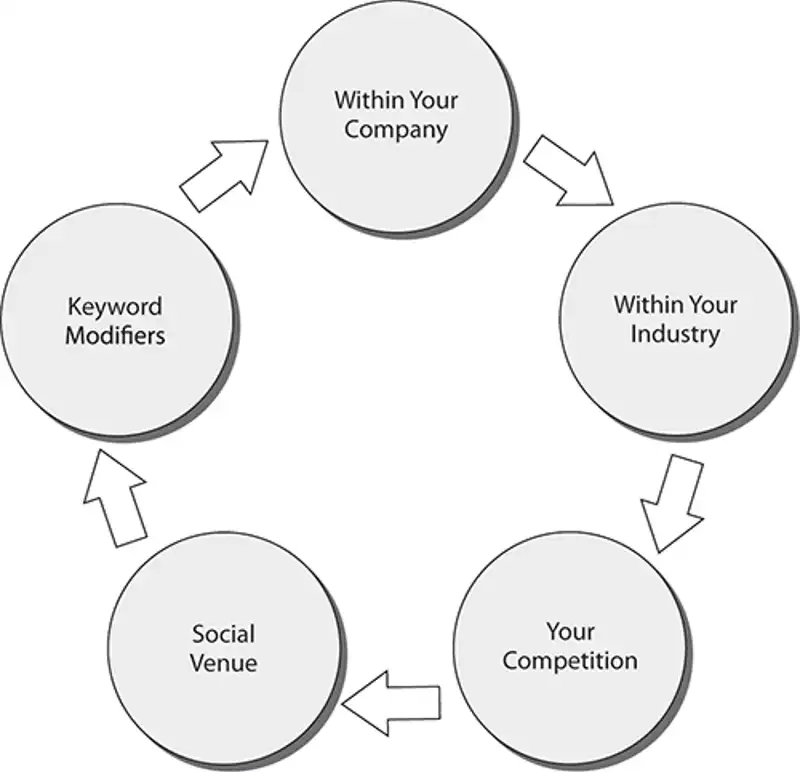
- Exhaust all internal resources within the organization.
- Study the industry
- Study the competitors within the industry, their marketing channels and KWs they used for these channels.
- Step outside the industry and study KWs used by public, seedkeywords.com can help, know what KWs consumers use.
- Modifiers: consider misspellings, plural/singular forms, variants to finalize.
Within your company
Consider dusting off your mission and vision statements and looking for words that speak to who you are as a company or a brand.
Places to looks for:
- Company statements, such as brand/positioning statements and mission and vision statements
- Press releases and news articles about you
- Product/service information and brochures
- Company websites, blogs, and social media sites
Tagline/Positioning Statements examples:
- Professional money management services for discerning investors
- Factory direct, fine luxury furniture
- Oak furniture for every room in your house
- Low-cost vitamins for active seniors
- Equity strategies for low-risk investors
Some more real life examples:
- Heinz “Our VISION, quite simply, is to be ‘THE WORLD’S PREMIER FOOD COMPANY, OFFERING NUTRITIOUS, SUPERIOR TASTING FOODS TO PEOPLE EVERYWHERE.’ Being the premier food company does not mean being the biggest but it does mean being the best in terms of consumer value, customer service, employee talent, and consistent and predictable growth. We are well on our way to realizing this Vision but there is more we must do to fully achieve it.”
- Sears “To be the preferred and most trusted resource for the products and services that enhance home and family life.”
- Amazon.com “Our vision is to be earth’s most customer centric company; to build a place where people can come to find and discover anything they might want to buy online.”
- Facebook “Facebook is a social utility that helps people communicate more efficiently with their friends, family and coworkers. The company develops technologies that facilitate the sharing of information through the social graph, the digital mapping of people’s real-world social connections. Anyone can sign up for Facebook and interact with the people they know in a trusted environment.”
Company’s Website
2 Methods besides web statements, marketing, web content:
- Site Analytics
- Log Analyzer
Site Analytics
Goal:
- To gain more Seeds;
- Gain some insight to the conversions.
Need to setup GA for a period of time and track valuable info.
Where to look at: Google Analytics - Traffic Sources - Keywords
How to use GA and objectives of GA:
P.S.: A high bounce rate means low conversion, a low bounce rate might mean a better conversion.
- Find KWs that converses well/badly
- Derived from the above goal, set up the conversion goal for the website and track conversion info tailored to these goals.
- Identify high-performing KWs.
Google KW tool can help to find KWs specific to the web defined.
Website Search Engine
Goal:
- To understand why some KWs are good;
- To gear the marketing campaign towards those KWs;
- To gain more seed KWs.
The terms you come up with provide only an educated guess as to how you can attract customers to your site.
A website search engine eliminates that guesswork. Need IT work to extract the data.
KIM that the most popular used KW doesn’t necessarily mean that the KW is good, it might mean you have some usability problems on your site or that the PPC campaign is driving the wrong traffic.
Within Your Industry
Find niche: Positions in the industry
Goal :
- Define your niche;
- Find relative Seeds to your niche;
- Explore other seeds in the industry that might be close fits to your niche.
First, understand what your place in the industry is.
Then, mine KWs related to the niche.
KIM that your Seeds should be relevant to your niche/position, E.g. if you target high-end market, it makes no sense to PPC a KW like “cheap XXX”, no matter how popular the latter one is.
2nd approach: Use KW Discovery to help find the industry themes/KWs/categories/groupings.
Other sources to zoom in industry phrases/jargons/terminology:
- Magazines/Journals: Find related publications online, including: articles/stories/reviews…
- Membership Organizations: Professionals often host events, programs, etc.
- Trade Organizations
From Your Competition
Goal:
- Gain more insight to competitors;
- Gain more relative seeds.
Research your competitors websites to be informed. Study their statements, branding messages, marketing campaigns. It even helps to find your own value proposition.
Social media and blogs
Goal:
- Gain more insights from outside looking inside;
- Gain more insights from the public perspective and consumer thoughts;
- Gain more seeds.
A source to find relative news: Technorati(www.technorati.com)
Focus groups and surveys
Goal:
- Gain more seeds
- Gain more insights
Another great method to find out consumer needs, wants, desires. E.g. Facebook groups, Twitter polls.
Hashtags
Goal:
- Gain more seeds;
- Gain more insight to the events;
Tools might help: Hashtags.org (www.hashtags.org)
Social tagging and tag clouds
Delicious (http://delicious.com/tag), StumbleUpon (www.stumbleupon.com/tag/), and Technorati (www.technorati.com/tag/)
Blogs and discussion boards
Where to look at: Blogs, Groups, Forums.
KIM: authority, frequency, and freshness
Goal:
- Gain more seeds(buzzwords and common phrases);
- Find relevant info;
Google Groups (http://groups.google.com) and Yahoo Groups (http://groups.yahoo.com)
Modify Seed KWs
Thesaurus
Merriam-Webster has a good online thesaurus at www.m-w.com. Thesaurus.com, at www.thesaurus.com, is even better, some other online dictionaries, synonyms.
Plural and Singular Forms
Make sure to cover both plural and singular forms.
Misspellings and typos
If the KW is challenging to spell, better to test the misspellings and cover these.
keyword typo generator: https://morganmarshall.github.io/typogenerator/
Prefixing
Think what the audiences might append before your seed KW.
Suffixing
Think what the audiences might append after your seed KW.
KW stemming
It’s a kind of discover the etymology of the KW.
E.g.
- Technology management
- Management
- Manage
- Managed, managing, manager, managerial, manageable, unmanageable, unmanaged, unmanagerial…
- Mix-and-match and wipe out the nonsensical.
- Switch places.
Summary
KIM:
- Record, take notes;
- Provoke creativity;
- Use spreadsheet to manage the findings;
Chap 5: 7 Steps to Refine KWs
According to this book, I have successfully developed several Python scripts tailored for Alibaba KW data that can :
- Convert Excel files to CSV files.
- Remove duplicates, outliers and defect data entries.
- Categorize keywords dataset into:
- 1-2 words Keywords
- 3-4 words Keywords
- long-tails
- Analyze and visualize the word frequency for each file:
- Single word frequency
- Phrase frequency(bigrams, trigrams, long-tails etc.)
- Normalize, standardize the data(Search Index & Competition)
- Calculate the relevancy and specificity based on natural language processing(NLP).
- Compute the weighted overall score and sort the data based on which.
File structure:
|-- KR-process-stage-1
|   |-- general-analysis
|   |   `-- alibaba
|   |       `-- test
|   |-- original-data
|   |   |-- KWDiscovery
|   |   |-- WordTracker
|   |   |-- alibaba
|   |   `-- moz
|   |-- overview
|   |   `-- alibaba
|   `-- preprocessed-data
|       `-- alibaba
|-- KR-process-stage-2
|   |-- overview
|   `-- test
`-- scripts

17 directories
Descriptions:
The scripts will first processes the data from original-data and export the results to the preprocessed-data folder; then do the general analysis, which is to analyze the words frequencies, to give a brief idea of the impact of the words, and then export the results to the general-analysis folder; then do an overview and export to results to the overview folder.
After all of which is done, the KR-process-stage-1 is complete. Then the scripts will analyze and compute the results according to these metrics:
- Relevancy
- Specificity
- Normalized click rate.
- Normalized popularity
- YeoJohnson Transformed search index
- Normalized standardized competition
- Normalized standardized search index
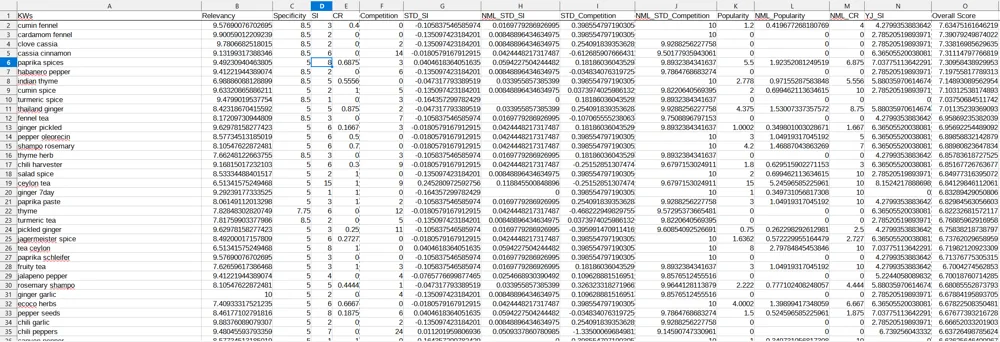
All metrics are scaled from 1 to 10. Weights are in NLP-KW-analysis.py. During the analysis process, the script will also output the statistics of each file. Popularity is the product of the search index and click rate. The normalized click rate, normalized popularity, normalized standardized search index, YeoJohnson Transformed search index all contribute to the popularity score in the book.
The NLP-KW-analysis.py utilizes several approaches, manipulations and strategies to quantize, analyze and compute these metrics. The algorithm contains four predefined sets of keywords which are essential to calculate the relevancy of the target keyword in the data set. These keyword sets are hard-coded in the script. They are: business-keywords, main-feature-keywords and unwanted-keywords, rare-terms. The script first vectorize the target keywords and these predefined keyword sets and then calculate the cosine similarity between the vectorization of the target keywords and the vectorization of the predefined keyword sets. The rare terms are used to calculate the specificity score. Generally speaking the lengthier, the more specific it is but it is not always the case. E.g. tremella or collagen tripeptide are short in length, but they are very specific and professional in specific fields. After the analysis, the KR-process-stage-2 is complete.
All the other manipulations refer to the book, Chapter 5.
A snippet of the final results:
Chap 6 Using KWs for SEO
Goals:
- Drive Traffic to Alibaba store by SEO organic traffic and P4P traffic, tailored to KWs to boost conversion:
- Determine the relations of product listing page content structure, page titles, URLs, metadata and so on.
- Define strategy for Alibaba product listing with the KWI and KW insights
Define strategy for Alibaba product listing PPC campaign, which is called P4P(Pay for performance).Chap 7.- Explore, determine and optimize the places in product listing:
- Product titles
- Product keywords
- Product descriptions
- Gang insights from the KWs analysis and explore its impact for the marketing campaign
- Product lineup with respect to the KW findings(e.g. I sell spices, and KW
spice grindershows up.)
- Product lineup with respect to the KW findings(e.g. I sell spices, and KW
- Determine traffic direction of Alibaba and website:
- Determine if I can direct traffic from Alibaba to the website.
- Determine if I can direct traffic from the website to Alibaba.
- Determine website design tailored to KWs
- Page content structure & management
- Titles
- URLs
- Metadata
Other resources:
- SEO for Dummies by Bruce Clay (Wiley Publishing, 2009)
- Internet Marketing: An Hour a Day by Matt Bailey (Sybex, 2011)
- Search Engine Optimization: An Hour a Day, Third Edition by Jennifer Grappone and Gradiva Couzin (Sybex, 2011)
- “Periodic Table of SEO Ranking Factors,” a great online resource from Search Engine Land at http://searchengineland.com/seotable/
- A comprehensive keyword research and its correlations to the ranking of the website on Google by Moz: http://www.seomoz.org/article/search-ranking-factors#predictions-4
To follow the instructions on this book. I use this link on Alibaba: Vietnam Orangutan Nuts Malva Nut / Pang Da Hai / Sterculia Lychnophora - Buy Vietnam Malva Nut,Malva Nut,Sterculia Lychnophora Product on Alibaba.com
Keywords and Their Role in SEO
Key takeaways:
- Site design accommodates visits from the bots.
- KW optimization
- Optimizing each page for no more than three keywords
- Places to optimize:
- Domain names
- URL string and file structure
- make sure you use a dash (
-) and not an underscore (_) to separate the words
- make sure you use a dash (
- Anchors and tags
- Site content
- Link Building(like votes)
Within each page of your site, you should add your keywords to the following specific areas:
- Page title
- Meta description
- Meta keywords
- Headings
- Body copy
Keywords in Domain Names
Skip, The weight of the keywords can impact and the rankings of the websites are. diminished over time.
Keywords in URLs and File Structures
Skip, I use odoo for my own website, and Alibaba store. No point.
Keywords in HTML and Tags
Goal:
Content is natural to the reader.
Here’s a screenshot of the example page that illustrates how Alibaba works its Urls, titles, keywords metadata.
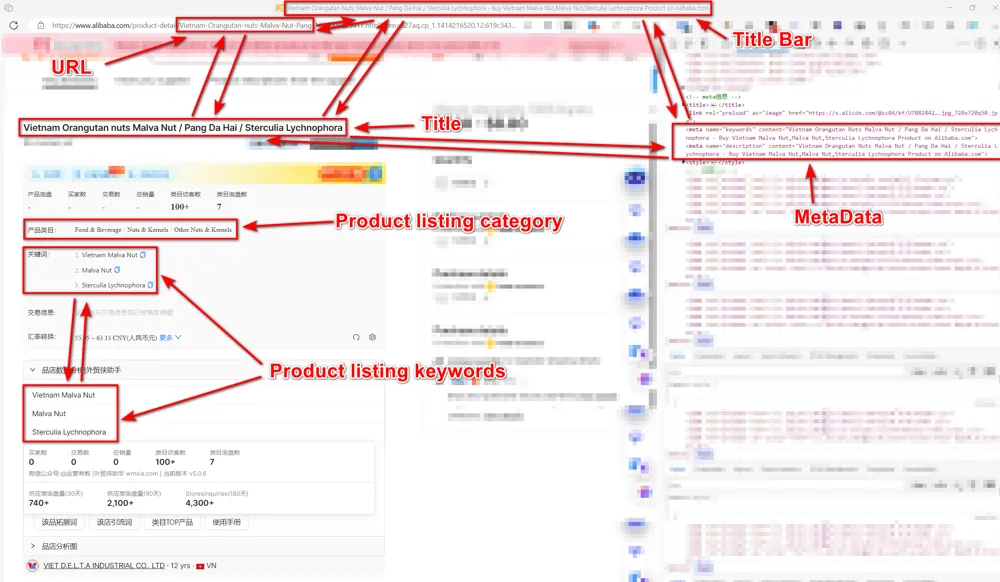
阿里巴巴产品名称==Title+产品关键词1+产品关键词2+产品关键词3==Metadata
E.g.:
产品名称(Product Name/Title):`Special sale vacuum pack dried lavender  for DIY scented capsule`
产品关键词1:`chinese tea distributors flower fireworks casing`
产品关键词2:`christmas decorations lavender flower sachet bags Essential Oil Raw Material`
产品关键词3:`lavender vanilla lavender flowers dried lavender plant`
最后的效果:
<title>Special Sale Vacuum Pack Dried Lavender For Diy Scented Capsule - Buy Chinese Tea Distributors Flower Fireworks Casing,Christmas Decorations Lavender Flower Sachet Bags Essential Oil Raw Material,Lavender Vanilla Lavender Flowers Dried Lavender Plant Product on Alibaba.com</title>

...

<meta name="keywords" content="Special Sale Vacuum Pack Dried Lavender For Diy Scented Capsule - Buy Chinese Tea Distributors Flower Fireworks Casing,Christmas Decorations Lavender Flower Sachet Bags Essential Oil Raw Material,Lavender Vanilla Lavender Flowers Dried Lavender Plant Product on Alibaba.com">

...

<meta name="description" content="Special Sale Vacuum Pack Dried Lavender For Diy Scented Capsule - Buy Chinese Tea Distributors Flower Fireworks Casing,Christmas Decorations Lavender Flower Sachet Bags Essential Oil Raw Material,Lavender Vanilla Lavender Flowers Dried Lavender Plant Product on Alibaba.com">
In sumamry, most important 3 KWs need to appear in title, URL, Meta description(trivial), Meta KWs(trivial), Headings, Body(trivial).
ALWAYS REMEMBER: ALLOCATE TIME EFFICIENTLY, EFFECTIVELY.
You should develop your page content first around your readers and then consider the search engines.
Keyword Density, Frequency, and Prominence
Keyword density measures the number of times a keyword phrase appears on a web page relative to the total number of words on that page. It is one of the factors search engines use to determine relevance to search queries.
The keyword density for any keyword phrase generally should not be more than 5 percent.
One final aspect to consider is keyword distribution. This measures whether the keyword is distributed evenly throughout the page and the site. As long as you have your keywords in the right places—title, URL, heading, and so on—then I recommend that your keywords are distributed evenly so your content reads and flows naturally.
For a landing page with 750 words, I recommend the following distribution of keywords:
- Once in the title tag
- Once or twice in the meta description tag
- Once or twice in the meta keywords tag
- Once in the heading H1 tag
- Twice in the first 200 to 300 words of readable text in the body copy
- Once in all paragraphs
Again, use your judgment and see how your document reads.
Keywords and Link Building
Internal Links: Anchor Text to another page(Anchor text the KW you want to optimize for).
Backlinks/Inbound links: All the links coming into your site(Think of it as the “votes” to your site.)
Example internal linking structure:
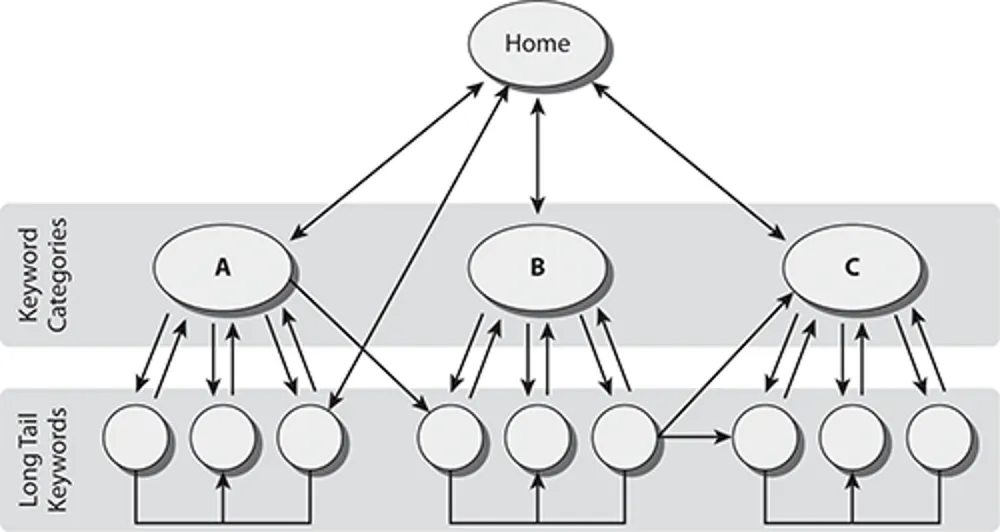
Internal Links
Contextual Link Building
Try to find sites like PR Newswire (www.prnewswire.com) that let you submit your article with links back to your site.
Links from Press Releases and Other PR Sources
Here are a few examples:
Public Relations Links can be included in press releases, an online newsroom, within email pitches to journalists and bloggers, in PDF documents of case studies, with media coverage, and so on. Also, here’s one of the best tips: When a journalist confirms they’re running a story citing your company, ask them for a link.
Directory Submissions
Before you go crazy and start submitting to thousands of directories, seek out local directories and directories that are specific to your business/industry.
Local Organizations
Join a local chamber of commerce and ask for a link.
Write an Insightful Article
Writing articles and submitting them to article directories.
Link Building with Social Media
Twitter, Digg, Reddit…
Generating Links with Twitter
- Build a Twitter profile around a specific topic and stick to it.
- Provide relevant, focused, and valuable tweets.
- Tweet often and consistently.
- Identify the major players in your topic/industry.
- Integrate Twitter into your website.
Remember to think in terms of offering something of value to others.
Just as with internal linking, it is optimal to get your keywords into the linked text.
Optimizing Image and Video Assets with Keywords
- Preparing images for SEO
For Images
- Use Descriptive image file name.
- Use Descriptive Alt and Title Attributes
- Use Descriptive Anchor Text
Use Descriptive Image and Folder Names
E.g: california-white-water-rafting.jpg
Use Descriptive Alt and Title Attributes
E.g.: alt="Malibu Ocean Kayaking near Dominica in the Southern Caribbean"
Use Descriptive Anchor Text
E.g.: [[For more information on Ocean Kayaking in the Southern Caribbean, click here.]]
Optimize Image File Size for Faster Load Times
Recommend: 72dpi(dots per inch) Pixels: 360 width, 250 height(Fit) Image quality: 50-80 Resample: Bicubic Format: Baseline webp
Images and Social Media
Social media has opened up new channels to market our products and services. Many sites that let you upload images, such as Facebook and Flickr, let you tag the images with keywords and descriptions. Make sure you take advantage of this. When you post images to these sites, use the target keywords you used in your image titles, attributes, and descriptions. Then make sure you link to targeted, relevant pages on your website. If you have your images properly tagged, you will likely find new visitors from these social sites.
For Video
- Use keywords in your video transcripts
- Video production
- Landing pages
- Uploading and optimizing videos
- Tracking/analytics
Use Keywords in Your Video Transcripts
- Title, description, filename, URL
- use long-tails for videos
Video Production
2 Styles:
- Pro
- Down-to-earth, vanilla and genuine
- 30 seconds to 3 minutes
- Talking points
- Call to action
- Can also be creative to cover all the functions of the products
Landing Pages
This is the place to direct the audience to the target page.
Uploading and Optimizing Videos
- Some tools can help to upload videos to various sites in one-click.
- Video search engines
- Add KWs to Title, description, and tags for each site.
- Title bw/ 75-120 chars
- Readable by humans
Tracking/Analytics
- VSEO
- metadata
- context surrounding the video
- unique URL
- Make video available for viewing in many places
- Decide objectives for videos
- Seeding, promotion
- …
What Opportunities Do VSEO Efforts Create?
- monetization
Chapter 7 Using Keywords for PPC
A healthy KW AD PPC campaign:
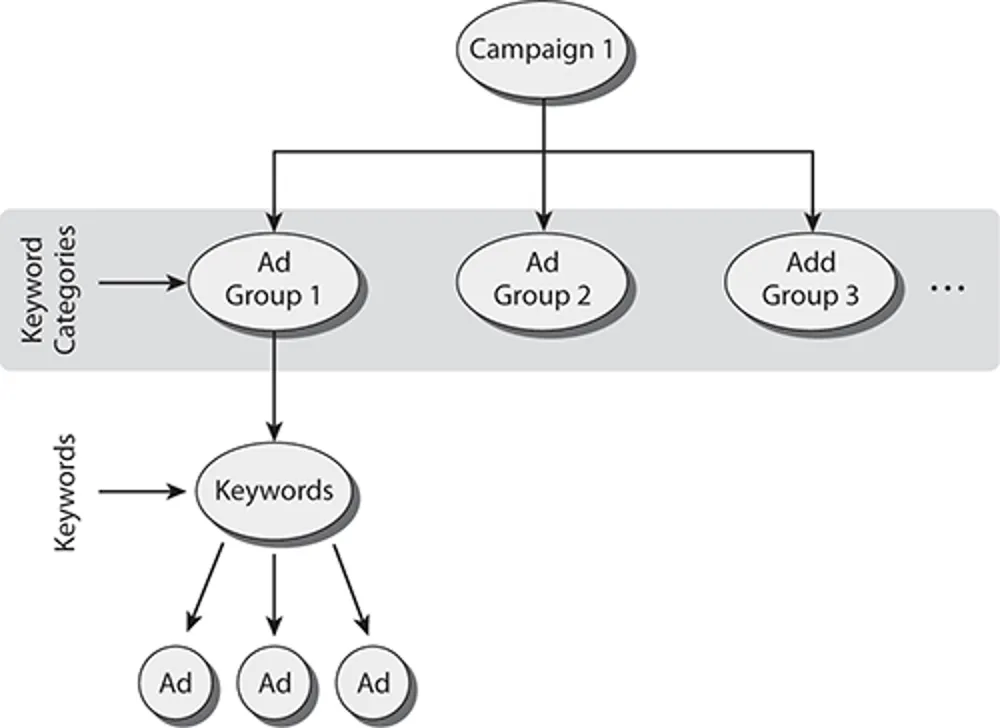
- Ad groups mimic the KW categories that created in earlier stages.
- Each category have its own landing page with great relevant content.
E.g.:
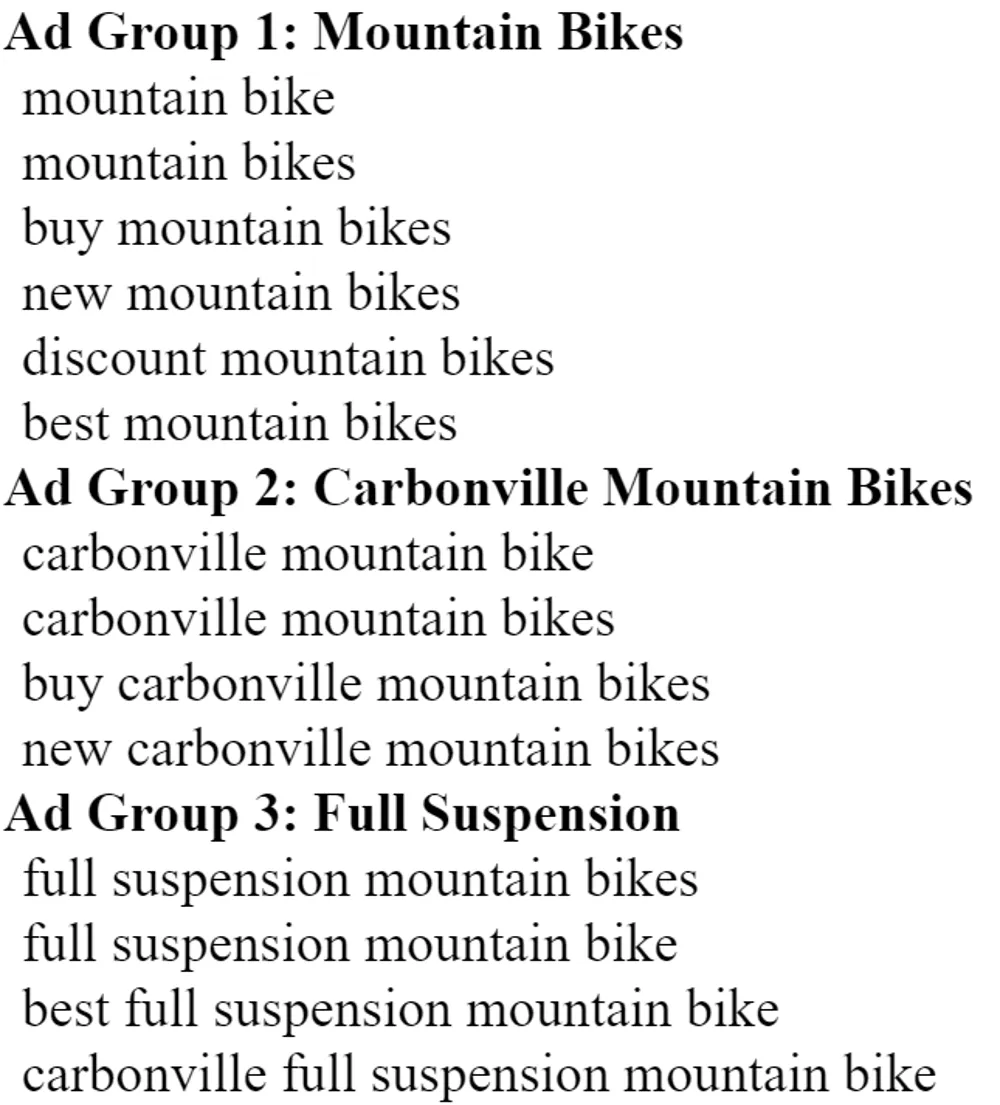
- No branding
Inspiration:
Match KWs categories to Alibaba product listing and product category.
General SEO and PPC KW approach:
- Core/general/branding KWs for SEO
- long-tails/specific KWs for PPC
SEO/PPC timing strategy 1:
start off with a strong PPC campaign to get you into the game early, and when your SEO efforts achieve the desired visibility, you can then back off on your PPC campaign to save money.
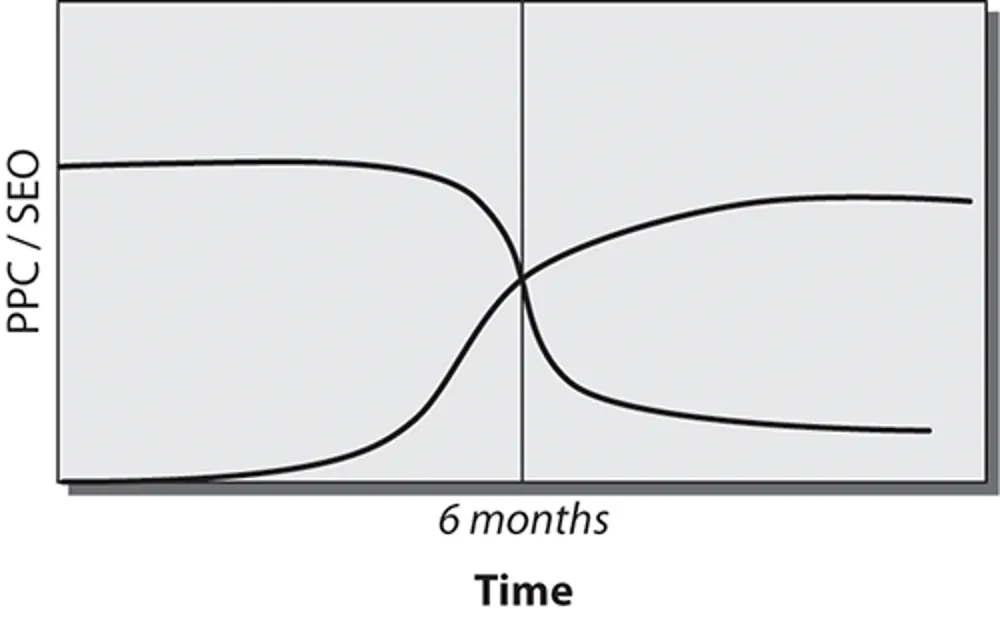
- writing relevant and engaging ad copy for each ad in each ad group.
- include KW somewhere in the ad, ad leads to a landing page which meet user search intent and expectation.
- divide up your keywords into smaller ad groups with fewer keywords that are centered on a strong theme
- create only one or two ad groups and put hundreds or thousands of keywords in them.
- write effective ad copy that is relevant to each of those keywords.
Ads and Ads groups
- Relevancy
- Action
http://www.google.com/intl/en/adwordseditor/ http://www.wordstream.com/wordstream-for-ppc
- at least two ads per ad group if not more.
- To ensure relevancy, each ad should have the core, or theme, keyword in it. Keywords can go into the title, description, display URL, and even the destination URL.
Using Keywords in your Headlines
- have an ad group that contains a smaller set of keywords and that are very similar to your headline
Dynamic Keyword Insertion
you place a short piece of code into your ad text. Each time the ad shows, the code will be replaced by the keyword that triggered the ad.
Keywords and Quality Score
Early pay-per-click advertising networks were based on price auctions where whoever bid the highest got the top spot.
In AdWords, the quality score is a dynamic value that is assigned to each keyword in your PPC campaign and indicates how relevant and competitive your keywords and ads combinations are relative to other advertisers competing for the same keywords; it is mostly based on the click-through rate of your ads
- reward advertisers that have a higher quality score
Quality Score Factors
- Relevancy
- CTR
High Quality Score practices:
1. Identify campaign strategy and goals: With any campaign it is always good to identify your strategy and goals. Is your campaign designed more for branding or is it a lead generation strategy? With that in mind, start conducting your keyword research and identify those phrases that will help drive the right traffic to your site.
2. Organize a campaign structure: Organize KWs into themes
3. Identify keywords and relevant ad copy: create many ad groups that contain keywords that are very closely related to each other.
4. Ensure landing page quality.
5. Measure performance: CTR, delete not performing ads after a month or so.
Case study in book: Quality Score Case Study
Using Negative Keywords
E.g. you sell luxury handbags and handbags if one of your KWs, but user might search for “Cheap handbags”, you want to negate those KWs.
This can:
- Lower PPC cost
- Improve relevancy and CTR
- Improve user experience
KW hit algorithm
4 matching types:
- Broad match: catch all
- Broad match modifier: include misspellings, plurals, stemmed forms…
- Phrase match: catch phrases
- Exact match: exact match, E.g. “tennis racket” for “tennis racket” noly.
Use negative KWs whenever as possible for conversions, not branding.
How to find Negative KWs: Using tools
Search Funnels
This is a way to understand how all the efforts work together.
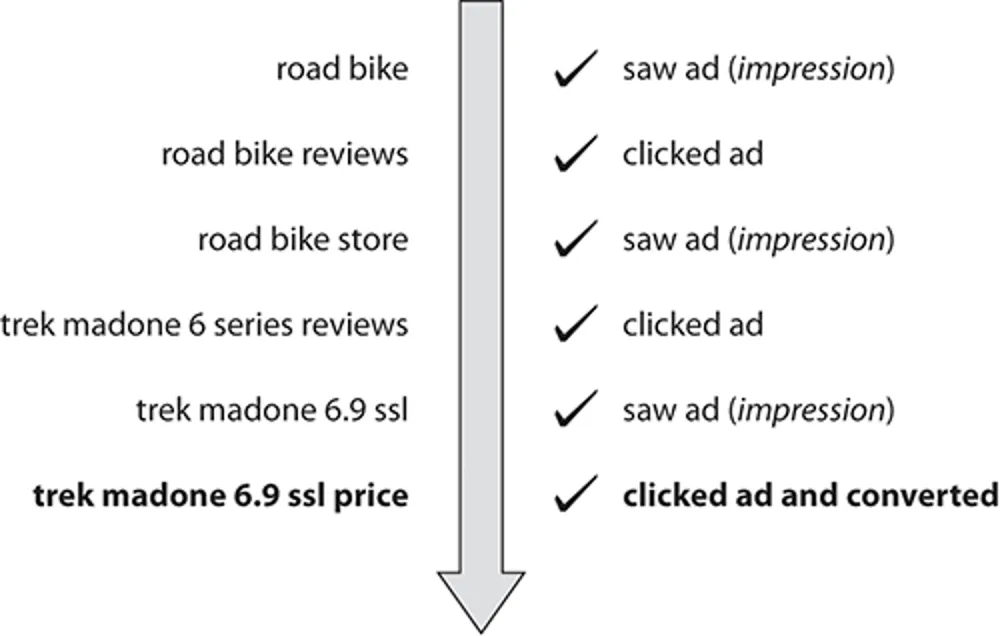
How Many Ads Do Your Users View Before They Convert?
How Long Does It Take Before Users Convert?
What Is Your Customer’s Search Process?
What Are the Most Common Paths Your Users Take to Convert?
What Are the Enabling Keywords that Support Your Conversions?
Review all your data and performances once a month.
Chapter 8 Using keywords for social media
Skipped
chapter 9 using keywords for mobile and local
Skipped
Chapter 10 Keywords and Site Architecture
How to create a site architecture that leverages your keyword research efforts.
The main goal here is that focus on the user’s experiences and information design.
Understanding Site Architecture
Understanding your site architecture
Key takeaways: two types of audiences:
- users
- search engines
Regardless, the most important aspect of this type of activity is to account for all of the information, establish its relevance, and make sure there is a logical flow. To make your users happy, you need to ensure that the navigation is fluid and information is easy to find and access.
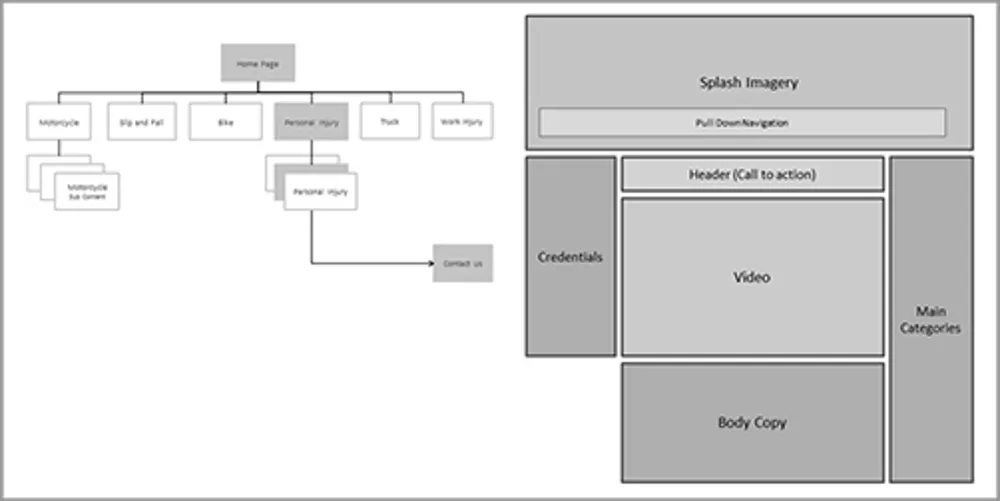
Relevancy, relevancy, relevancy.
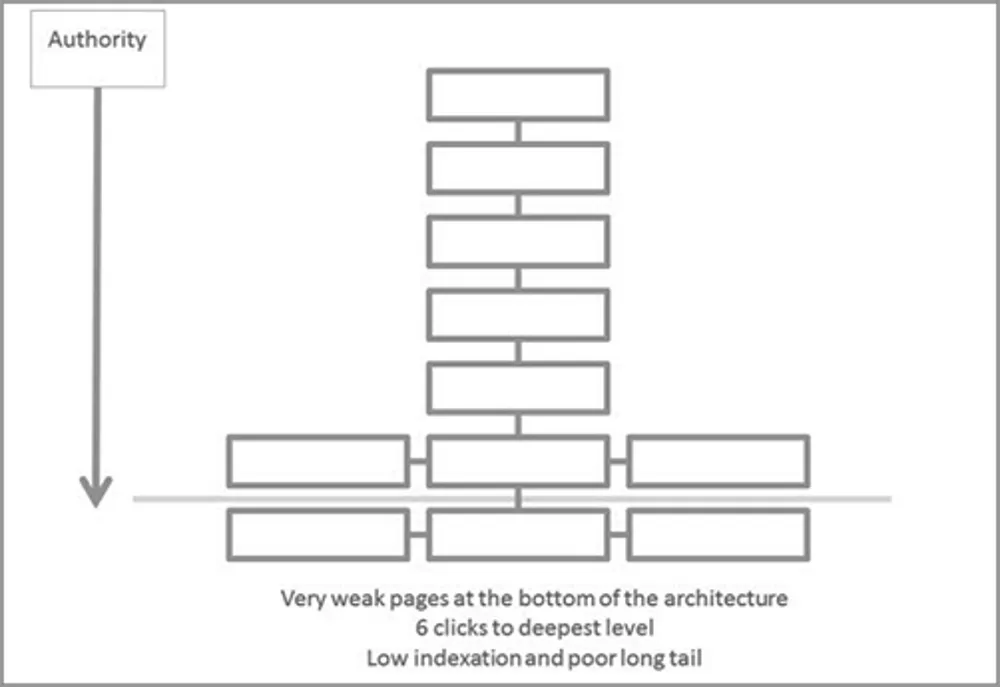
KEEP IT FLAT AND STUPID SIMPLE.
A poor site architecture:
Flattened site architecture:
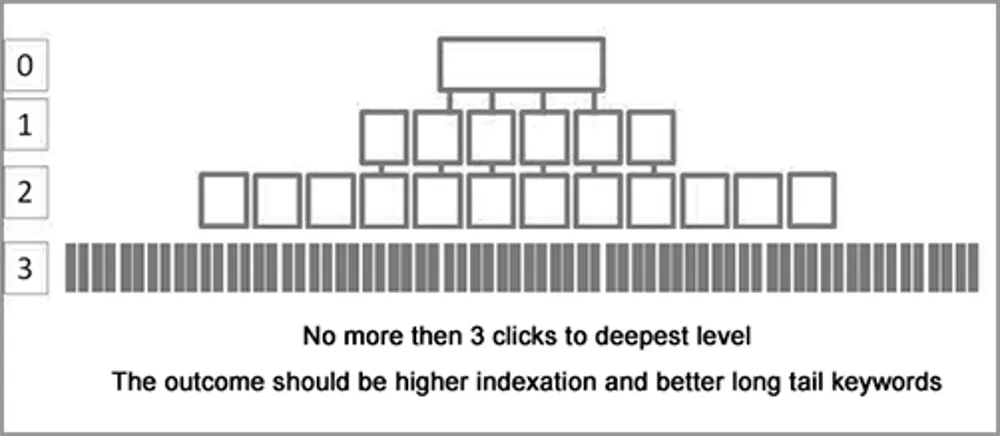
Keep relevancy inside out, upside down, always. Keep relevancy inside out, upside down, always. Keep relevancy inside out, upside down, always.
Keyword modeling
E.g.
| 401 k plan |
| 401 k plan contribution limits |
| 401k account |
| 401k advisor |
| 401k contribution limit |
| 401k contribution limit 2011 |
| 401k contribution limits irs |
| 401k contribution limits over 50 |
| 401k early retirement |
| 401k employer contribution limits |
| 401k for self employed |
| 401k management |
| 401k plans for small businesses |
| 401k retirement savings plan |
| 401k rollover advice |
| 401k rollover into ira |
| 401k rollover options |
| 401k rollover rules |
| 401k rollover to ira rules |
| 401k rollover to roth ira |
| 401k savings plan |
| 401k to roth ira rollover rules |
| 403b account |
| after tax 401k rollover to roth ira |
| best roth ira investment |
| early retirement planning |
| early retirement strategies |
| employer 401k plans |
| estate planning |
| estate planning asset protection |
| estate planning living trust |
| estate planning strategies |
| family limited partnership estate planning |
| fee based financial planning |
| fee only financial planning |
| how much do I need to retire |
| how much money do I need to retire early |
| how to manage 401k |
| how to manage your 401k |
| how to retire early |
| how to rollover 401k to ira |
| how to set up a self directed ira |
| independent financial advisor |
| independent investment advisor |
| independent registered investment advisor |
| independent retirement account |
| individual 401k contribution limits |
| individual 401k plan |
| individual retirement account |
| investment advisory firm |
| ira accounts |
| ira contribution limits |
| ira investment account |
| manage 401k |
| manage my 401k |
| personal financial management |
| personal retirement account |
| portfolio analyzer |
| portfolio asset allocation tool |
| retirement account |
| retirement calculator |
| retirement financial advisor |
| retiring early |
| rollover ira |
| rollover ira account |
| roth ira |
| roth ira account |
| roth ira investment |
| roth ira investment choices |
| roth ira investment limits |
| roth vs traditional 401k |
| sec registered investment advisor |
| self directed 401k rollover |
| self directed individual retirement account |
| self directed ira |
| self directed ira 401k |
| self directed ira account |
| self directed ira investing |
| self directed ira investment options |
| self directed retirement account |
| self directed roth |
| self directed roth ira llc |
| self directed solo 401k |
| self employed 401k contribution limits |
| self managed 401k |
| sep 401k |
| sep ira contribution limit |
| simple 401k |
| top investment advisors |
| ways to retire early |
| wealth management software |
| what happens if I retire early |
| what to do when you retire early |
keyword groupings:
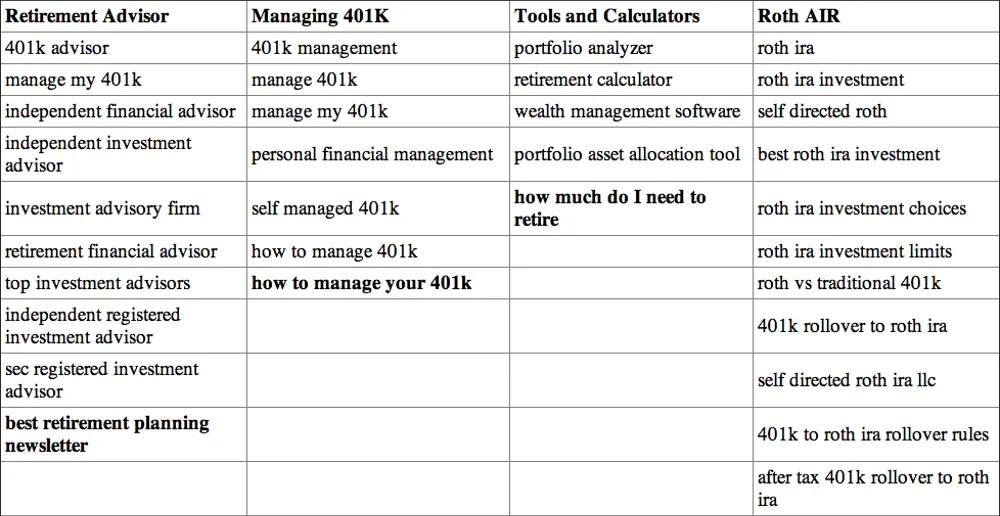
Website architecture:
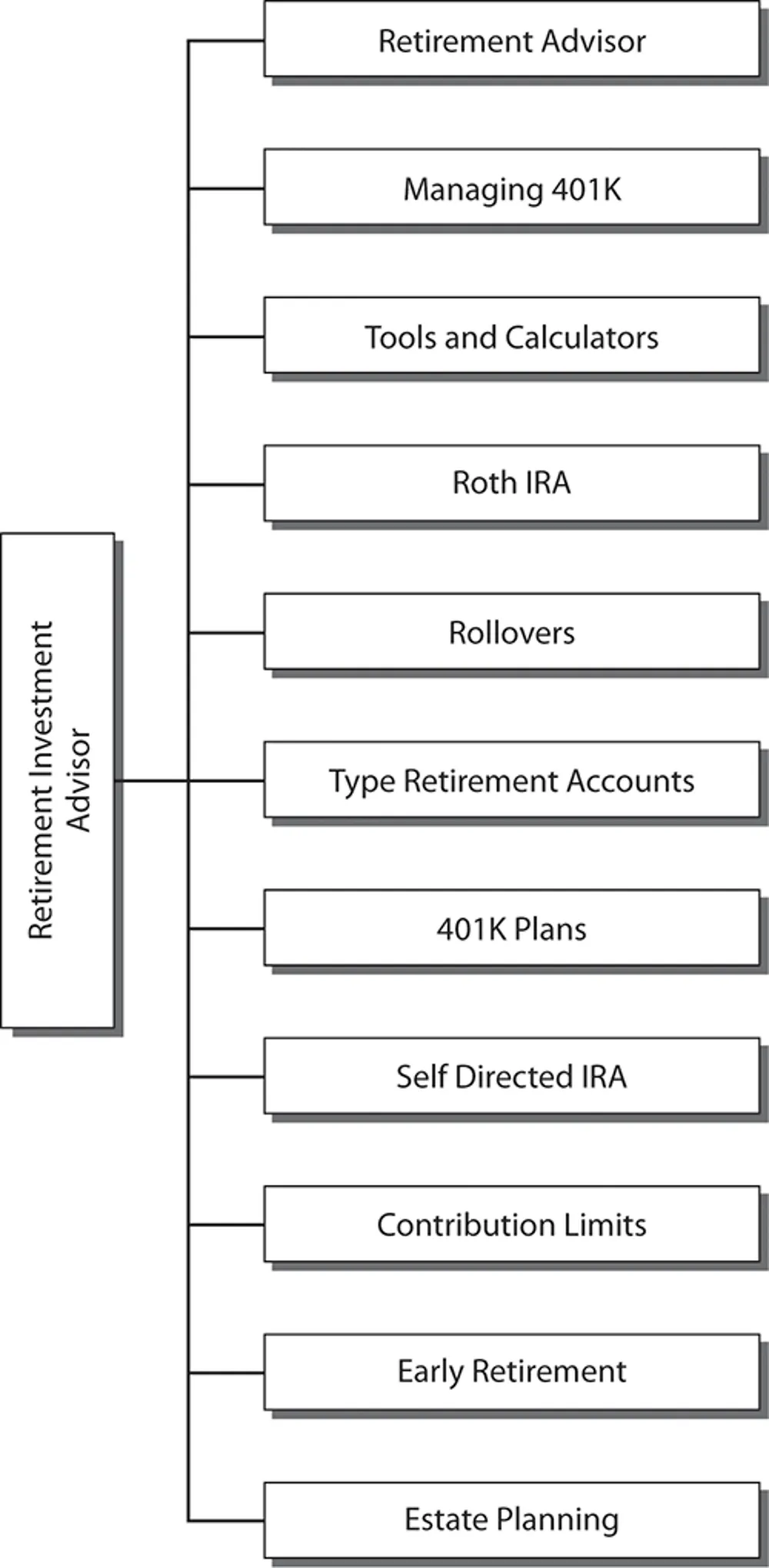
Tip:
Use KW groupings found from the KW research as top-level categories for your site architecture.
If you have an existing site just focus on the biggest problem, you don’t necessarily need to restructure your site completely
Mapping keywords to your site structure is an excellent way to build a solid site foundation. To do the job completely, you need to look at the rest of the keywords in your targeted list and outline them in logical places.
Step 3 Developing your personas
E.g. Tailored to individuals who are seeking advice for retirement planning.
- Derive personas based on the keyword search queries, Learn target audiences’ objectives and motives. Build personas tailored for just that.
- Build site architecture.
Table 10-3: Persona development mapping:
| Keywords | Personas | Objectives |
| estate planning strategies, early retirement strategies, | Seasoned and Experienced Investors | Get premium service advice after subscribing; renew premium service subscription |
| how to manage your 401k, how to retire early, how much do I need to retire | Entry-level or DIY investors | Get free information, investment ideas, DIY information |
| 401k advisor, independent investment advisor, retirement financial advisor, 401k rollover advice | Individuals seeking retirement investing advice | Find financial advisor or planner; buy advisory servic |
Figure 10-6: Search term types used by personas:
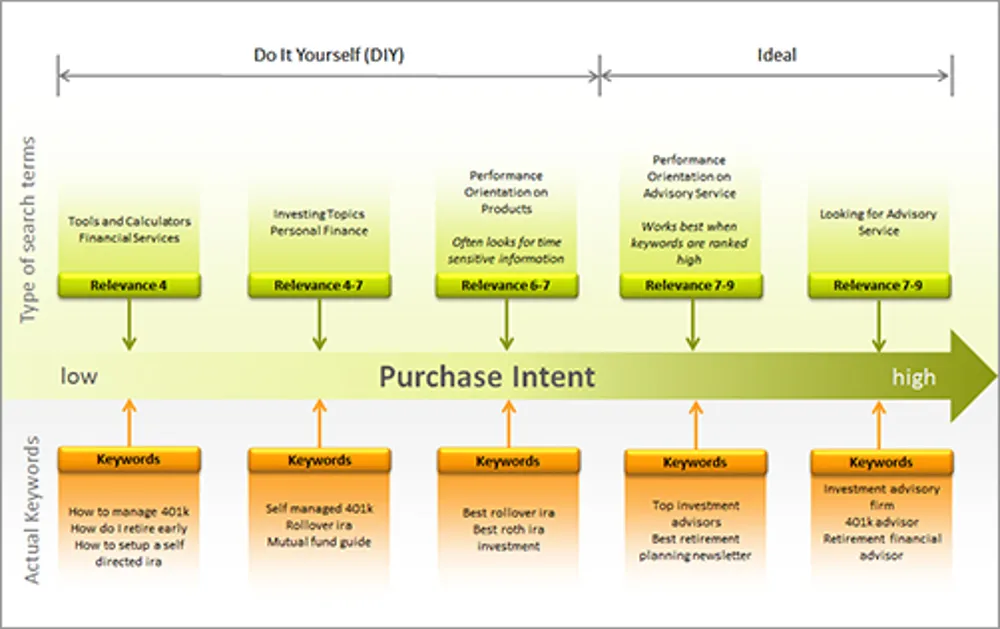
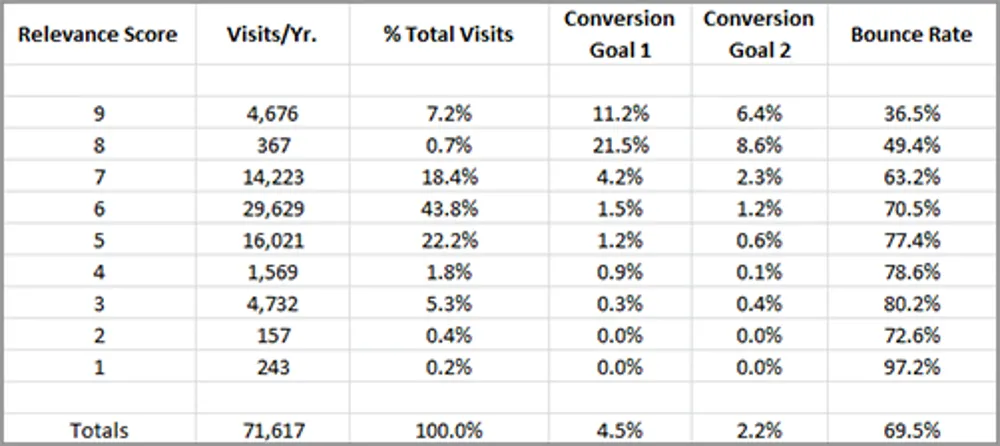
Figure 10-7: Relevance versus conversion:
Step four content design
Focus on one major keyword phrase per page, plus one or two permutations. Your top-level pages, which are your home page and primary navigation pages, should focus on the more general head keyword phrases. As you drill down into your site, use more long-tail keywords.
You might use a blog section to capitalize on long-tail keywords and provide some incentive to draw more specific traffic to your site.
First take all of the content pages from your site mapping diagram and list them in a text document. For each page of your site, list the primary and secondary keywords. Using these keywords as a guide, create the actual keywords you will use for your title tags, URL strings, H1 tags, and so on.
E.g:
Home Page (Retirement Advice)

Keywords: 401k advisor, retirement financial planner, retirement planning

URL: /www.yoursite.com

Title: Top Retirement Planning and Financial Planning Advice—Name of Company

H1: Retirement Planning Advice
Managing 401k

Keywords: 401k management, manage my 401k, how to manage my 401k

URL: /401k-management/

Title: 401k Management | YourCompany

H1: Managing your 401k
Estate Planning

Keywords: estate planning, estate planning strategies, fee based financial planning

URL: /estate-planning-advice/

Title: Estate Planning Advice | YourCompany.com

H1: Estate Planning Advice
Now that you have this document in place, you should share it with your development team. Your programmer can use the keywords to build a site structure that uses them as filenames, which will help to form a keyword-rich URL string. They can also build each page to include the tags from the beginning. Your content development folks can make sure they develop content that includes the exact keywords you have in your document. This will ensure that you have consistency for the entire site development process even though you have many people working on it.
Step five wireframes and prototyping
Tools: ProtoIO,
Tip
First Test functionality and information flow. Content logics. Make sure SEO are filling all the metadata, KWs in their places, URL string, headlines, titles. Then add graphic elements.
Chapter 11 Creating Great Content with Keywords
Let’s look at some of the things that Google considers “quality content.” Google has provided a list (http://googlewebmastercentral.blogspot.com/2011/05/more-guidance-on-building-high-quality.html) of questions you can ask yourself as you consider developing content for your site.
Written by an expert: Content should be written by someone who knows and understands the subject matter well. Make sure you seek out experts to help you develop the very best content for your pages. You can arm them with your keyword list and invite them to write using your targeted keywords. You will find that the content will be more believable and engaging because your passion for the topic is more evident if it is written properly.
Keyword variations: Do not duplicate content for multiple pages and then switch out different keywords. You should make sure each page is distinctly written around the main topic or idea. If you have mapped your keywords to each page, you should already have a good idea of what content to write. Also stay away from redundant articles on the same or similar topics. Each page or article should have a purpose and should be unique.
Genuine interest of readers Each page or article should map to the genuine interest of your readers and visitors. To accomplish this, you can first look at your top keywords and analyze them against the buying cycle as discussed in Chapter 1. Specific long-tail keywords suggest that a searcher is at the end of their search and is ready to buy, whereas the broad, less-specific terms suggest that a searcher is in the information-gathering stage.
When you analyze keywords with social media tools, you can put them into the proper context by seeing how they are used in a sentence or a conversation. Using these tools and methods can help you learn what readers really want to know and what their needs and intentions are. With this intelligence, you can produce of content that will be worthy of your readership and will capture their interest.
Good value As you consider the content you plan to produce, you should seek out what has already been written on the subject. How does your article stack up to others that have been written? Is it unique or are you just repurposing someone else’s content? Are you providing the right amount of detail or is it just a summary?
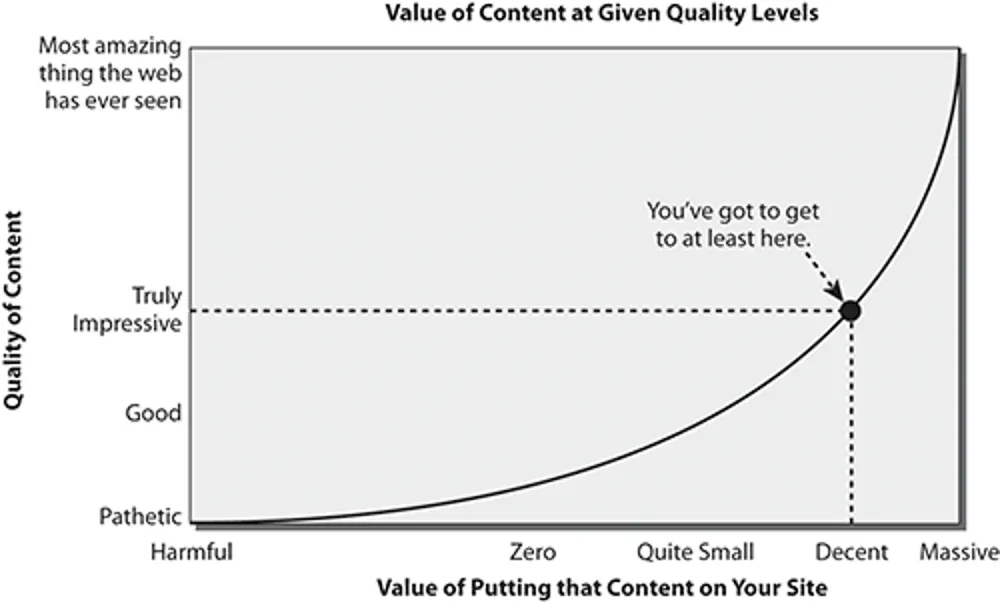
Basically, good enough just won’t cut it anymore. You really have to dig down deep and find ways to raise the bar and provide significant and valuable content. From what I have read, the search quality algorithms Google deployed in its Panda update are not going away anytime soon because Google seems to like the positive impact it has had on the quality of search results. Google will continue to refine its algorithms, but the underlying principle of favoring great web content will probably always be a primary factor in its ranking schemes.
Writing for the Web
Tips:
Fast formation, short, small, fun, Provide more detailed information to another page. Use media like the vidoes pictures and audio.
Ready for the search engine
It is best practice to always write for your human audience first and foremost, and to integrate keywords into your writing in a logical, sensible way to also ensure that your content is search-engine friendly.
Copywriting
Relevant and expert content that answers a question and fulfills the customer’s need is the ultimate goal of copywriting. Integrating targeted keywords into your copy will help you accomplish this goal. Remember to always write to serve your customers’ needs first and keyword-rich copy will flow naturally.
Call to action
Headlines
The purposes of headlines :
- Found by search engines
- Enticing readers
both can be satisfied.
Keywords for the Headlines should be specific and long-tail.
Additionally, headlines that list a number of tips, reasons, types, and so on will work for you because they make very specific promises. Just make sure you deliver on that promise.
how-to headlines
Page body
goal: compel your reader to read on to the next sentence, and then the next paragraph, and so on to the end where you will likely have a call to action.
Word count: 600 to 800.
People tend to scan text on the Internet, so keep the paragraphs short and direct. Provide facts and figures concisely and to the point. Use lists and bold and italicized text to direct your visitor’s eye to important points, keywords, and concepts.
So identify the specific, unique aspects of your topic and write about what sets you apart from the others or your value prop or selling point at the very beginning of the body.
Table 11-1 Identify content topics from keywords:
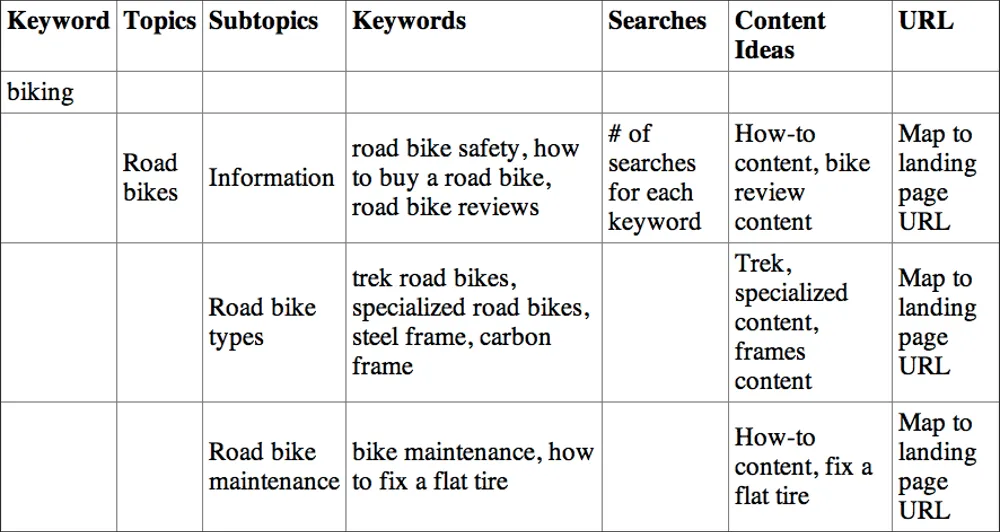
jotting in ideas that come to your mind.
As you conduct keyword research with social media tools, you can find even more ideas of what people are interested in. Add those insights to your spreadsheet as well to provide a better context.
Furthermore, you can conduct some competitive research to find out what content you can provide that others are not providing. Add that to your list.
When it comes time to produce quality content, you have a great place to start with some ideas that come directly from the keyword research you have already done. You may then need to find a subject matter expert or creative copywriter to craft it into the type of content your readers will clamor for. You can be assured that it will be the type of content they are interested in and want to consume.
The overall strategy for most companies is (1) how to attract more customers and (2) how to engage them more effectively.
SEO drives right audiences, great content help you engage them.
So your strategy needs to have components of all three: content, SEO, and social media.
Content Management
If you need to constantly develop new content, you may need a way to organize your thoughts and plan ahead.
Advice:
developing an editorial calendar to manage and plan all of your content.
E.g:
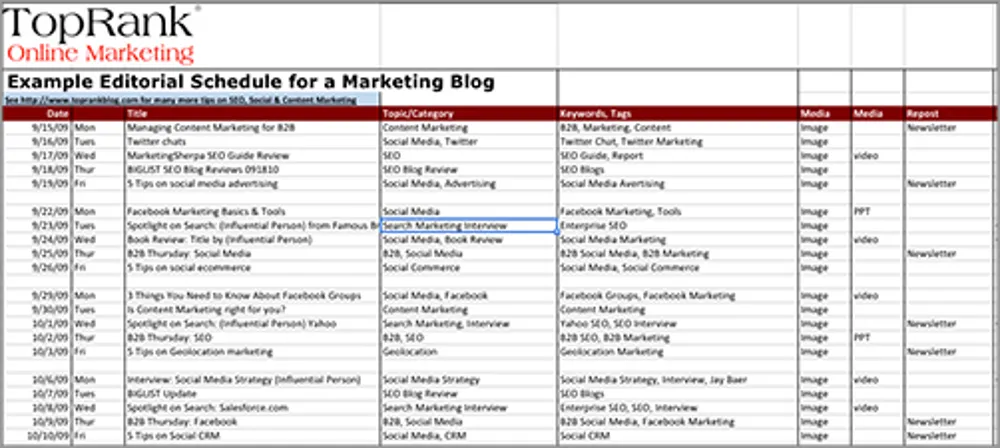
Content Marketing
Content should be designed for your readers first and foremost. At the same time, that content should include keywords that can attract new readers through search and social recommendations. This will help you make your content great as well as findable and shareable.
Tips:
Needs are varied. Monitor, measure and refine. Relevancy, relevancy, relevancy
Digital Asset Optimization(DAO)
Many of the same principles apply as with SEO, but they can be extended to various media types that are now found on the SERPs, like images, audio, video, PDFs, slide shows, and more.
Aspects to look into:
- Filenames
- Captions
- Videos
Furthermore, use keywords in tags for all images, video, and audio, including alt text for images.
Map Keywords to Digital Assets: For instance, if you have a keyword phrase “how to fix a flat tire” on your list and it is a popular search, a video is a great way to show exactly how to fix a flat.
Produce the video with a script that uses the keyword phrase, and make sure you tag and use the keyword phrase in the filename
Then post the video on YouTube and embed the video on your website.
Chapter 12 Using Keywords for Branding and Messaging
The engagement cycle revisit:
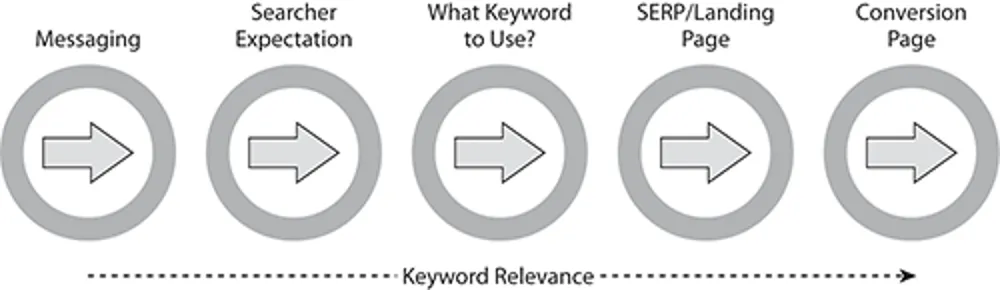
The cycle begins with some kind of trigger that causes people to become interested in a product or service. There are many triggers out there that are not advertising related. However, the role of advertising is to get in front of your target audience with a message that either leaves a favorable impression or is a trigger to cause them to “act.”
Once they decide to act and start the process of gathering information online (assuming it is not a completely offline sequence of events that leads them to the local Starbucks for a cup of coffee), they first form an expectation in their mind, or a visual that represents what they expect to find. Because we are all used to viewing web pages, it is quite possible that this representation in their mind may be web content that includes product information with images or video, comparisons to other products, pricing, availability, and so on.
With that in their mind, they head off to their favorite search engine and attempt to convert the information in their head into the language of search, which is keywords. They need to somehow come up with a search query that is a best guess and will hopefully provide listings of sites that deliver on this expectation. At this point, they usually go back and forth visiting different sites, maybe even refining their search queries until they are ultimately confronted with the content they envisioned in their mind.
They view and study the content and get outstanding questions answered before they head to the conversion point, where they decide to buy, download, call, or contact. This conversion happens after they are satisfied that they have all the information they need to take the next step.
If your website is optimized around the search terms they used and it has the content and the structure that helps them realize the expectation they envisioned, then it is more likely they will reach your conversion point and do so quickly. The role of SEO and paid search is to get your site visible within search engines. The role of your website or landing page is to convert. However, getting them to act in the first place depends on awareness building activities, much of which can be traditional advertising and promotion.
The Keyword Research Brief
Five Elements of a Keyword Research Brief
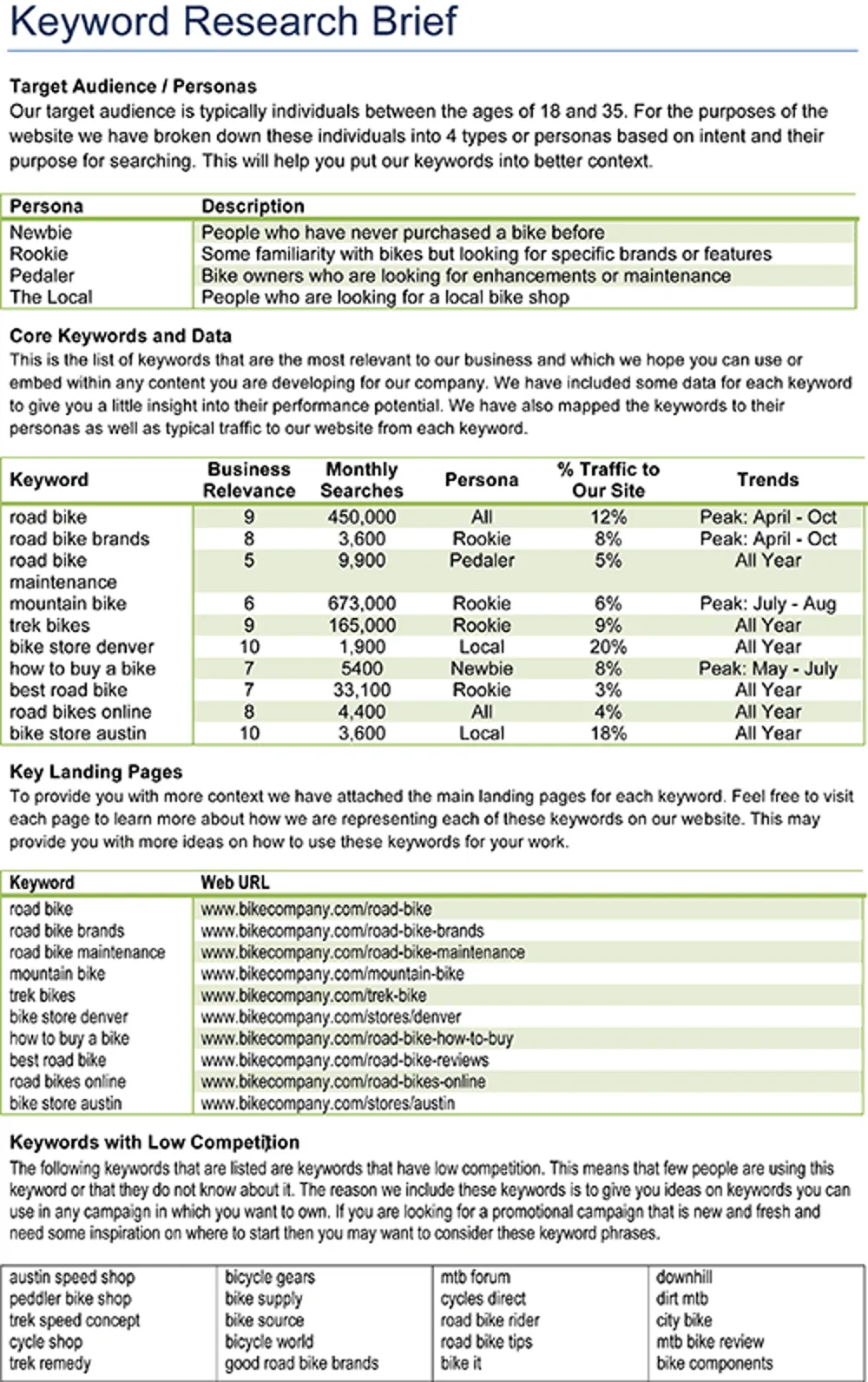
- Element 1: Audience/Persona Expectation
- Element 2: Core Keywords to Use: include sensible data
- Element 3: Key Landing Pages
- Element 4: List of Unique, Low-Competition Keywords
- Element 5: Keyword Usage Tips
- hyperlink KWs, not
click here. - others
- hyperlink KWs, not
Keywords in Brand Positioning
Every company has its brand. Whether or not it’s capturing attention. Customers and prospects are continually interacting with various aspects of your business. They are gathering information, forming impressions, and making judgments and even decisions based on actions you take and don’t take.
Brand positioning is all about taking charge of the perception and influencing what and how people think about your brand.
Six Steps to Stronger Brand Positioning
1Step 1: Determine Current Positioning - What word or phrase comes to mind when you think about our company? - What does our company do differently than anyone else? - What does our company do best? How are we unique? - What target market characteristics are most important and relevant in affecting their behavior to make a purchase? - What is the main reason someone would buy from us? - What is your product’s frame of reference? In other words, how would you describe the competitive set or category in which you compete? - What one user benefit do you want your customers and users to identify with most readily?
Step 2: Assess Customer Needs: Ranking the following, which aspect matters most in my company? Take not of each one. - Increasing operational efficiency - Reducing risks - Getting projects completed quickly - Leveraging existing investments and platforms - Building organizational capacity for training best practices - Providing measurable results to management - Minimizing company involvement with turn-key solutions - Customizing for unique company needs - Taking risks to become an innovator and leader - Possessing domain expertise and competence - Building human capital for the company
Step 3: Assess Competitive Landscape:
You may even want to plot these on a graph to visualize where they all fit in the positioning landscape. Are there any holes or gaps? Do these gaps represent opportunities for you to own that space? Maybe there are ways of looking at your competitors’ positioning statements so you can appeal to customers in a different way. What keywords are they using to position themselves?

Are there different phrases you might want to use to be unique? What are they? If you have access to a keyword research brief, look at the list of noncompetitive keywords. Do any of these keywords stand out or are they unique? You may not find the exact keyword you are looking for, but this list may spark new ideas.
Step 4: Develop a New Brand Positioning
understand how you want your target to think about your product or service.
The essence of positioning is sacrifice. You must give up something so that what follows is focused. No brand can successfully be all things to all people. To be successful, your position must be long term, unique and protectable, single minded, focused, consistent with product or service delivery, and built on your brand’s desired image.
As you gather information from the first three steps, including keywords that have surfaced, start crafting new positioning statements. The key is to attempt to use keywords that are part of your targeted list. Be prepared to create good content on your site around any new keywords that have surfaced. You will also need to add them to your list of targeted keywords.
As you build out new statements, consider generating a list of three to five that can be tested and validated. Here are a couple of examples:
We are the best at ______ because of our ability to ______ .

If you need ______, choose us because of ______.
Step 5: Validate the Positioning
Survey:
- Overall, how do you feel about this statement? (Highly favorable=1 to Highly unfavorable=5)
- How important is this statement to you? (Highly favorable=1 to Highly unfavorable=5)
- How well do you believe ‘Your Company Name’ can deliver on this statement? (5 point scale: very unlikely to very likely)
- Does this statement take a long-term view of your business? Is it enduring? (Highly favorable=1 to Highly unfavorable=5)
- Is this statement compelling? Does it state a premise worth participating in? (Highly favorable=1 to Highly unfavorable=5)
- Is it simple and credible or does it require further explanation? Is it believable given the proof you have to offer? (Highly favorable=1 to Highly unfavorable=5)
find what works and what doesn’t.
Step 6: Execute and Deploy the Positioning
The website, collateral material, messaging, and all other types of communications should be updated to use this statement.
Chapter 13 International Keyword Research
International, as in multilingual.
Search Engine Colossus (www.searchenginecolossus.com). Ethnologue (www.ethnologue.com)
Google results may differ from country to country
cultural differences: some languages do not currently have 100 percent agreement on standards for grammar and spelling. This makes it difficult to identify the right keywords to use. To make matters worse, searchers may drop accent marks and space words differently than the proper word style.
For example, the Spanish version of the US phrase kick the bucket, which means to die, is estirar la pata. If you decided to do a literal translation from English to Spanish, the folks in Spain would think you literally meant to kick a bucket. If you translated the phrase from Spanish to English, the meaning would be to stretch your leg.
Localize with the right tool or experts.
Step 1: Discovery, Refinement, and Segmentation
First, do KR in English. Then localize in local language.
Step 2: Variations in Different Languages
Characters in different languages may vary. Like Japanese writing systems, Chinese characters, arabic, etc.
E.g.:
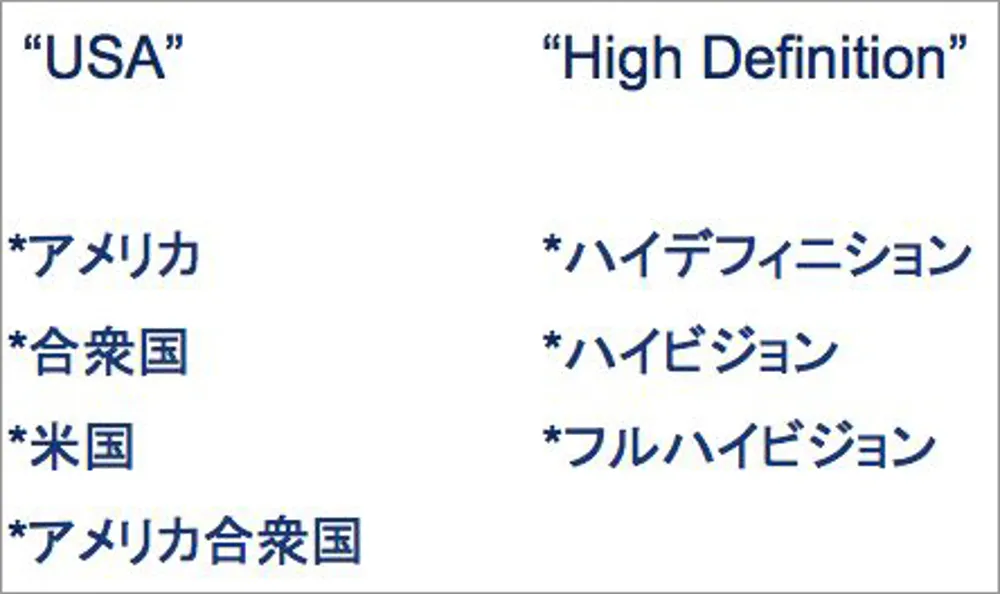
look at each of your target languages and identify all of the variations that might exist for your keyword.
Step 3: Translation
E.g.: Another example is for the keyword “projectors”. The German word for projector is “projektoren”. There are fewer than a thousand searches per month for this term. What a German calls a projector colloquially is a Beamer
Use appropriate words localized.
Step 4: Find The Right Partner
- Work with an agency (specific keyword research with a local language)
- Work with localization expert (native mother tongue speakers)
- Work with freelance native speaker of the language
If you feel the work at this point is over your head and you want to hire professionals, an agency might be the thing for you. Companies like WebCertain (www.webcertain.com), Global Strategies International (www.globalstrategies.com), and Localizations.com (www.localizations.com) make up a talented group of multicultural professionals who are mother-tongue linguists and have also been trained in search engine marketing.
Working with Localization Experts and Native Speakers:
- Needs to be a mother tongue
- Simple search experience
- Background with your subject matter
Ask for Back Translations
Ask your researchers to provide you with back translations of the keywords you are researching. This will allow you and your team to evaluate the keywords in the proper context. Back translation is a process of translating a keyword that has already been translated into a foreign language back to the original language.
One suggestion is to develop a glossary worksheet on which the local word(s) and the English equivalents are noted.
Expanding Your International Keyword Lists
Trados (www.trados.com).
review any pages where the search and replace has happened to ensure you have maintained the correct content, message and tone.
The best tool worldwide is the Google keyword suggestion tool (https://adwords.google.com/select/KeywordToolExternal).
There are specific search engines that you can use to do keyword searches for local markets, like Baidu (www.baidu.com) for Chinese and Yandex (www.yandex.com) for Russian.
Chapter 14 Keyword Measurement
Defining Metrics for Success
Here are some of the most notable goals for a successful outcome:
- Increased overall website visitor traffic
- Increased keyword rankings and top keyword placement
- Increased brand awareness
- Increased generated revenue and ROI
- Specific behavioral insights from your target audience based on keyword usage
market research and human behavioral analysis.
Measuring Keyword Performance
One of the best ways to do quick tests on your keyword performance potential and related messaging is to set up a mini PPC campaign for keywords from your final list.
Using PPC to Test Keywords and Marketing Messages
The variables involved in the test are as follows:
- Keywords
- Ad groups
- Ads
- Landing pages
Figure 14-1: PPC Test campaign flowchart
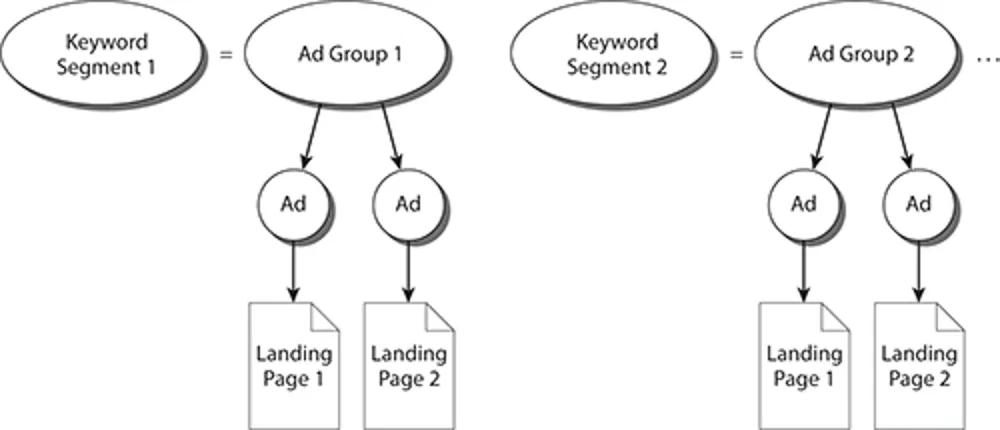
The keywords you want to test should already be segmented into logical groups. These groups become your PPC ad groups. Select exact match for your keywords to give you the best results. Phrase match modifiers can be used, but the tests will not be as accurate. Avoid broad match completely for these tests.

Next, you should build out ads for each ad group. If you are testing these keywords for SEO effectiveness, write your ads with your meta description tags in mind so that your ads simulate your organic search listing in the SERPs. The click-through rate of these ads will help you understand which messages resonate best with your target market so that you can write the most effective meta descriptions for your web pages.

For each ad, you should have a specific landing page that you also want to test. Do this for each keyword segment you want to test. By testing landing pages, you will be adding more complexity and time to the testing procedure, but it will help you better understand how your landing pages will perform relative to your keyword campaign.

On the website, you will obviously make sure you have your analytics set up ahead of time, including your landing pages.

The scenario you want to put together in an SEO test case is to mimic as closely as possible all of the variables you would have if you were running an SEO campaign.

Once your test PPC campaign is in place and your site is tagged and set up, you can launch your campaign. Here are the metrics you will collect and analyze:

- Keyword impressions
- Keyword clicks
- Keyword CTR
- Keyword average position
- Ad impressions
- Ad clicks
- Ad CTR
- Ad average position
- Landing page visits
- Landing page bounce rate
- Conversions
- Conversion rate
The landing page component of your quick test will help you understand how well the keywords you are targeting and the messaging in your ads work together with your web page and if the web page is delivering effectively on users’ expectations.
E.g:
So let’s look at an example. I will continue with the bike example and choose to test the following keywords, which make up the keyword segment (carbon frame road bikes). Here are the keywords:

carbon fiber road bikes (2,900 monthly visits)

carbon fiber bikes (14,800 monthly visits)

carbon road bikes (14,800 monthly visits)

I pulled these keyword estimates from the Google Keyword Tool. When pulling your keywords from a keyword suggestion tool, note the number of monthly/annual visits so you can compare to actual visits from your test campaign.

I place these keywords into an ad group and develop a couple of ads to test. Here are two that I came up with for this example:

Carbon Fiber Road Bikes

www.roadrunnerbikes.com

Custom carbon fiber bicycle

frames built & painted in USA

www.roadrunnerbikes.com/testpage1

Carbon Fiber Bikes

www.roadrunnerbikes.com

Best quality carbon fiber

bike frames all hand built

www.roadrunnerbikes.com/testpage2

Notice that in these two examples, I use two distinct marketing messages—one that emphasizes hand-built quality and the other that keys in on “made in the USA.” The more separate and distinct the ad copy messages are, the more likely we are to get clear, unambiguous data from our quick PPC test. Notice also how I write the description lines to closely mimic the way it might appear as the snippet in the organic SERP listings. My landing pages will be similar to each other but with slight variations based on the ad message text—one with the USA message and one with the hand-built quality message—so I can test each landing page’s bounce rate, conversions, and conversion rate. Now I will go ahead and launch the PPC campaign and test the results, shown in Table 14-1, Table 14-2, Table 14-3, and Table 14-4. I will run the campaign until I get enough data to make statistically valid observations. I like to shoot for tests that run at least two weeks, but I prefer to go longer when I have the time and money so that I have higher confidence in my tests.
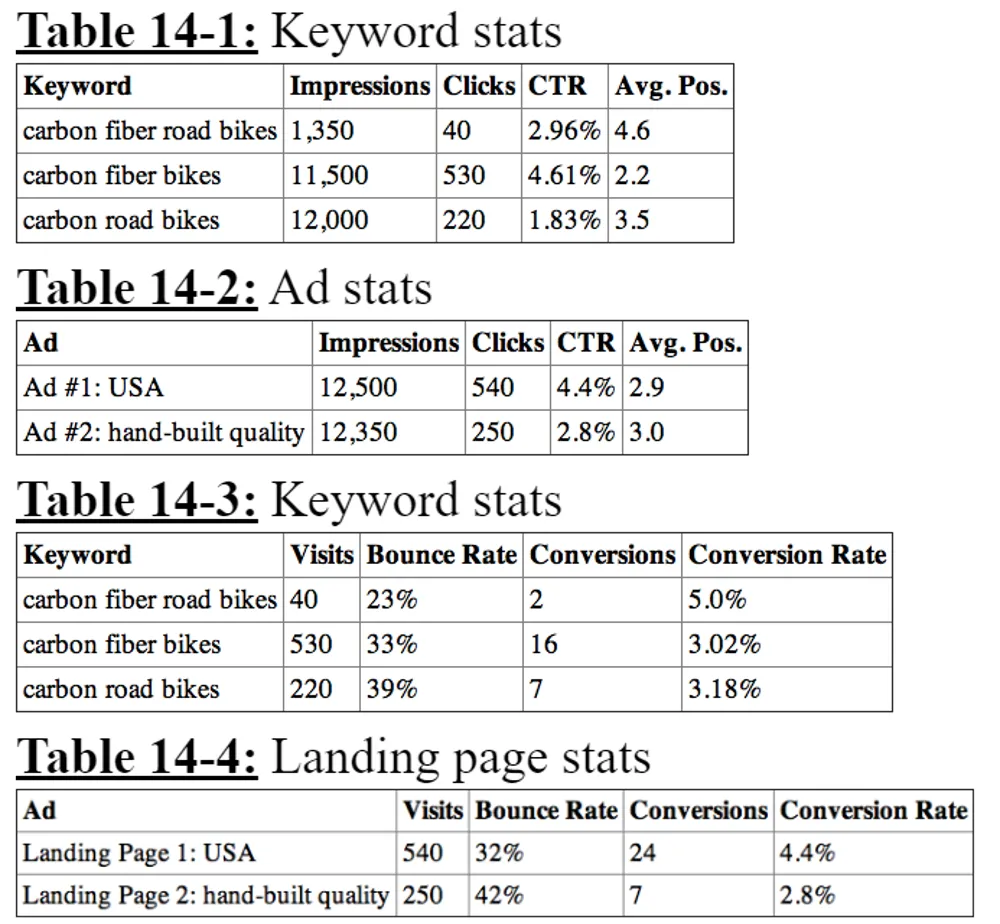
Based on these figures, I can see that all of the keywords had some decent results; however “carbon fiber bikes” had the highest CTR at 4.61 percent and it had the highest number of clicks. If I move on to the performance on the website, I learn that, as expected, “carbon fiber bikes” had about the same conversion rate as “carbon road bikes”. Both of them had a relatively low bounce rates at 33 percent and 39 percent, respectively. There simply wasn’t enough volume on the keyword “carbon fiber roadbikes” to draw any conclusions from on the conversions, but the lower bounce rate, even with only 40 observations, appears to indicate that it may be a powerful long-tail keyword. A longer testing period could possibly firm up that conclusion.

So from an overall performance perspective, the keyword “carbon fiber bikes” should be the one that is primarily used within the landing page because it seems to resonate with users better, which can be observed in the higher CTR. The others still had decent performance but not quite as high.

For the ads and the landing pages, I learn that those with the term “USA” seemed to perform better than the ones without. This tells me I need to make sure that the “made in USA” is included within the landing pages as well as the meta descriptions.

With information like this, I can feel more confident in pursuing these keywords, and especially “carbon fiber bikes”, and that they are likely to perform as planned. If a test like this had been run for just two weeks, I would consider running it for an additional two weeks to verify the numbers, especially if the data volumes are low. If it ran for a month or more, it would likely yield the answers you need.
Testing Your Google Ads
In the previous example, I touched on landing page testing because landing pages are an important part of the success formula in testing keywords. However, you can also learn a great deal from ad tests that do not take the landing pages into account and primarily use the CTR for measuring performance. One common way is to use Google for ad testing. In Campaign Settings within the AdWords interface, make sure you select the radio button labeled “Rotate: Show all ads equally.” If you have checked “Optimize: Show better-performing ads more often,” Google will serve the ads with the highest CTR more often. You can be relatively sure that your ads will be served almost equally during the same time periods. However, because one of the ads could be held in editorial review, you should make certain that all your ads are running before you begin testing.

Start by creating four to six ads per ad group, and test messages and styles that are widely divergent. Gross messaging differences—fast versus cheap, for example—will yield faster results and allow you to weed out poorly performing ads and messages.

Once you have reduced your messaging options, you can start testing more specific aspects in your ads, such as singular versus plural, offers, promotions, discounts, capitalization, and display URL variations.

Another good way to perform these types of split tests is to use a feature within AdWords called the AdWords Campaign Experiments (ACE) option. This relatively new feature allows you to create split tests of ads, landing pages, bids, and positions and control the amount of traffic that goes to the ads under test.
Keyword Rank Reports
Keyword ranking reports can be an indicator that your SEO efforts are heading in the right direction, or not. However, you need to be careful because they, in and of themselves, do not directly tell you much about your overall performance goals. The true indicators are that you are getting more traffic. So as I discuss this topic in more detail, please keep in mind that keyword rank reports are just a means to an end. You have to put them into a larger context to get a truer picture.
Google Webmaster Tools (www.google.com/webmasters/tools)
Search Query Report
KIM:
Broad matches data results are somewhat inaccurate.
Other Rank Reports
There are other reporting tools, like Web Position (www.webposition.com) and Advanced Web Ranking (www.advancedwebranking.com),
Utilize google analytics
Analyzing your brand keywords and other keywords separately, Because they share different metrics
Focus of mainly on the organic traffic
Note the number of pages visited, And the average number of pages viewed.
The two metrics doesn’t necessarily indicate a positive income
Keyword Analysis Spreadsheet Tracking
You can compile data ets from different tools and bring it all together into a spreadsheet
have a set of tabs for each keyword segment or theme.
for each of your segments, add some extra columns for more data. The two I use most often are for keyword ranking and web analytics
E.g:
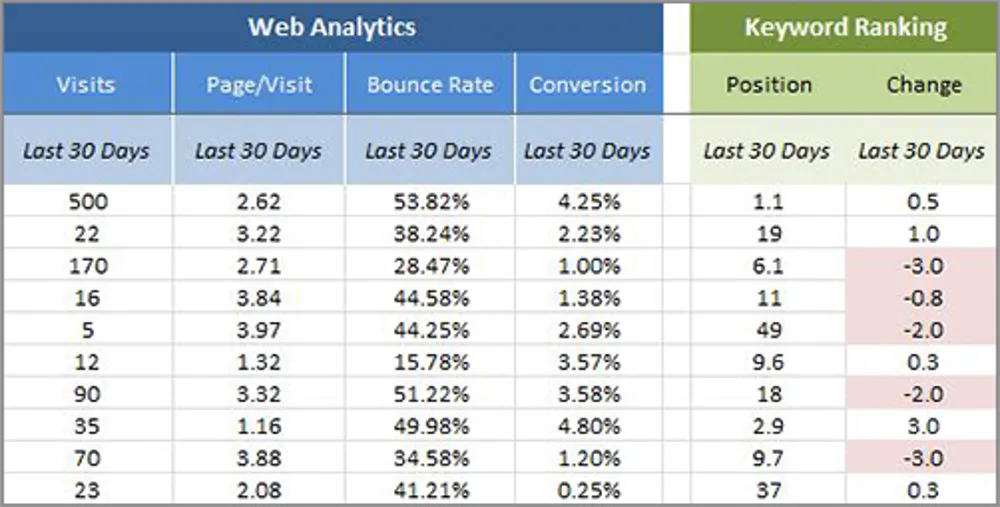
track keyword position and the positive or negative change from the previous 30 days.
do the same thing for web analytics.
set up four columns to track the following variables:
- Visits
- Page/Visit
- Bounce Rate
- Conversions
Figure 14-11: Full scoring and monitoring spreadsheet example:

Scoring Relevance Specificity Competition Popularity Overall Score Keyword Research Data Competition Index Avg Minimum Bid Search Volume Web Analytics Data Visits Page/Visit Bounce Rate Conversion Rate Keyword Ranking Current Position Percent Change
As you monitor your keywords on a regular basis and make updates to this spreadsheet, you will come up with recommendations for small course corrections. It doesn’t hurt to have yet another column to note any actions you plan to take to fix keywords that are not performing.
Setting up goals and tracking performance to see if those goals are met is essential. It is one of the best reasons Internet marketing is so great. You can track everything.
Index
Index
Symbols and Numbers
for Twitter hashtag
@ sign in Twitter
200+ B2B negative keyword list
A
About box in Facebook
actions, and ad groups
ad groups
for testing
AdGooroo
Adobe Photoshop, and image optimization
Advanced Web Ranking
advertising
copy, and quality score
display URLs in
keyword use in
qualifying traffic
role of
and searcher behavior
social media vs. traditional
AdWords Keyword Tool. See Google AdWords Keyword Tool
AdWords Performance Grader (WordStream)
agency, for international keyword research
Alexa
alt attribute (HTML), for images
AltaVista
Amazon.com, keywords in URL string
ambiguity, in keyword interpretation
anchor text
for images
Anderson, Chris
Archie
articles, writing
Ask Jeeves
assist click
assist impression
Assisted Conversions report
attainable goals
auction model, limitations
audience. See target audience
audience/persona expectation, in keyword research brief
audio, optimizing for
authority
of blog
of link
AutoComplete box, in Facebook
top ranking factors
automated rank checkers, skewed search values from
awareness
AWStats
B
back-of-book indexes
back translations
backlinks
Baidu
Bailey, Matt, Internet Marketing: An Hour a Day
banner advertising
behavioral design of website
benchmarking
bids on keywords, approximate cost of
Bing
Business Portal
keyword data from
blinkx
Blogger
blogs
basics
frequency of updates
keyword research for
as keyword source
keywords in conversations
platform for
setting up
terminology shifts in
top 10 lists
body copy
keywords in
bookmarks
online management
social
bots, skewed search values from
bounce rate
example
Bowman, Jessica
brainstorming
brand
and ambiguity
and focus on broader keywords
keyword research for
meaning in other languages
positioning
competition assessment,
customer needs assessment,
determining current,
developing,
executing and deploying,
validating
brand awareness, as social media goal
branding campaigns, keyword research in
brief. See keyword research brief
BrightEdge
broad match
broad match modifier
broad term, in search
browser toolbar, data from
business actions, strategy document on appropriateness
buying cycle
keywords and
Time Lag report and
C
calendar, for website content management
call to action, and web page content
CAPCHA
captonyms
CastTV
categories
and audience segmentation
and sitemap
ceiling number, for popularity survey
chamber of commerce, and links
character count, for ad headlines and copy
Chinese, Baidu search engine for
City-Data.com
Clay, Bruce, SEO for Dummies
click-through rates (CTRs)
example
for long tail keywords
negative keywords and
relevant ads and
clickable prototype
ClickZ
Clix Marketing
collaboration, Seed Keywords tool and
comma-separated values (CVS) file, importing to spreadsheet
company, as keyword source
Compete
Compete Pro Search Analytics
competition
assessment of
checking information available to
Google AdWords data on
as keyword source
as marketing team challenge
scoring for
competitive analysis tools
competitive intelligence
keyword gap analysis
metadata of competitors
comScore
Search Planner
Conductor
consumers, terminology selection
contact information, placement on website
content management system
for blogs
for website
content marketing
content of website
design
importance of quality
as marketing team challenge
writing
context, for video
contextual link building
conversation mining
conversation, on Facebook fan page
conversion rate (CVR)
goals setup in Google Analytics
for long-tail keywords
negative keywords and
for testing ads
conversion rate, example
conversion tracking
conversions
determining enabling keywords that support
relevancy and
in search engagement cycle
in search funnel
search funnel reports for
copywriting
core keywords
in HTML tags
in keyword research brief
cost per acquisition (CPA)
cost per click (CPC)
approximate cost of bid
on long-tail keywords
cost per conversion (CPC), negative keywords and
costs, competitive keyword and
couponing sites
Couzin, Gradiva, Search Engine Optimization: An Hour a Day
Covario
CPA. See cost per acquisition (CPA)
CPC. See cost per click (CPC)
crawler
crowd-source tool
CTRs. See click-through rates (CTRs)
customer experience
phases, and mobile strategy
support after purchase
customers. See target audience
D
Danuloff, Craig, Quality Score in High Resolution
dash
in file names
in URL, search engines and
data on keywords
sources for
variations in
databases, in Keyword Discovery
Deciphering Mobile Search Patterns: A Study of Yahoo! Mobile Search Queries (white paper)
Deep Software Log Analyzer
deeplink directory submission
Delicious
Dell, Idea Storm
demographic group in Facebook
density of keywords
description
keyword insertion method for
for video
destination URL, keywords in
Digg
digital asset optimization
Diigo
direct report organization structure
directory submissions of websites
discussion boards, terminology shifts in
Display Campaign Optimizer
display URLs, in ads
DM (direct message)
Dogpile.com
domain names
for blogs
keywords in
dpi, print vs. web
drive-to-site campaigns
dynamic insertion of keywords
dynamic website, and keyword optimization
E
editorial calendar, for website content management
effectiveness of social media strategy, measuring
embedded organization structure
Emtage, Alan
enabling keywords, determining those supporting conversions
engagement
on Facebook fan page
in social media, measuring
Ethnologue
exact match
Excel
data sort
Microsoft plug-in for keywords in
Excite
expectations of searcher
drive-to-site tactics and
in keyword research brief
marketer delivery on
experts
for content writing
localization
F
adding blog links to
fan page setup
engagement and conversation,
keyword optimization
keyword research for
keywords in conversations
link building in
maintaining page
polls on
search functionality
Facebook Lexicon
Faves
Fay, Sarah
Feedburner
file size of images, optimizing for faster load time
file structures, keywords in
filenames
keyword use in
filtering, with negative keywords
Find Us on Facebook badge
findability
finding keywords
brainstorming
mind mapping
sources for good keywords
within company,
competition,
within industry,
keyword modifiers,
social media,
finding negative keywords
Firefox, View Page Source
first-stage searches
Fishkin, Rand
Flash, links in
flattening site structure
Flikr
focus groups, as keyword source
folder names
forums
frequency
of blogging
of keywords
freshness, of blog information
G
Generate Local Adwords & Keyword Lists
generic keywords. See also head terms
GetListed.org
global monthly searches
Global Premium database, in Keyword Discovery
Global Strategies International
glossary worksheet
goals
for ad campaign
for conversion rate, Google Analytics setup
as marketing team challenge
SMART for setup
in social media strategy
brand awareness
GoDaddy
converting speech to text
keyword data from
Panda updates
and quality content
results differing between countries
search results, description tag information in
Wonder Wheel tool
Google ads, testing
Google AdWords Editor
Google AdWords Keyword Tool
advanced options
Competition data from
limitations
Local Monthly Searches column
Reporting And Tools tab
Assisted Conversions report,
Path Length report, ,
Time Lag report, ,
Top Paths report
results page
Traffic Estimator
Google AdWords Keyword Tool for Mobile
Google Analytics
keyword monitoring in
for social media monitoring
tags for
Google Groups
Google Insights for Search
Google Keyword tool
search value
Google Places
Google+
Google Research Blog
Google Suggest Mobile
Google Trends
Google Video
Google Webmaster Tools
Query Stats
Top Queries report
GPS
Grappone, Jennifer, Search Engine Optimization: An Hour a Day
grouping keywords
Groupon
guarantees, in ad description
H
H1 tags, keywords in
handheld devices. See mobile phone search
hashtags
Hashtags.org
head terms
headings, inserting keywords
headlines
asking question
character count for ads
of press releases
writing
heteronyms
Historical Global database, in Keyword Discovery
historical graph, from Keyword Discovery
hits, as website traffic metric
Hitwise
Top 10 Websites
Hitwise Search Intelligence
holidays, influence on searching
homographs
homonyms
homophones
Hot Frog
HTML
keywords in
viewing on competitor’s site
human behavioral analysis
human resources, links from
I
images
alt and title attributes for
descriptive anchor text for
for Facebook fan page
keyword tags
optimizing
optimizing file size for faster load time
and search engines
sharing
and social media
inbound links
indexing
videos
industry, as keyword source
Industry Categories, in Keyword Discovery
influence, in social media, measuring
influentials
information seekers, tools valued by
informational keyword classification
InfoSeek
InfoUSA
insertion of keywords, dynamic
Insights for Facebook
Insights for Search (Google)
interdisciplinary collaboration
internal links
international keyword research
challenges
expanding lists
process
discovery, refinement, and segmentation
finding partner,
language variations
translation,
tools
Internet
information search on
search engines
Internet Marketing: An Hour a Day (Bailey)
Internet marketing teams
challenges
organizational design
Internet Server application programming interface (ISAPI)
interpretation, of keywords
iPad
iSpionage
J
Japanese
JavaScript, links in
job listings, links for
Justinmind
K
KEI (keyword effectiveness index)
keyboard, vs. mobile devices, search trends
keyword data, sources for
{keyword: default text} code
Keyword Discovery (Trellian)
databases
interface
Keyword Trends
limitations
premium account
projects
results and graphs
search term filters
search value
Trends
keyword effectiveness index (KEI), in Wordtracker
keyword gap analysis
Keyword Grouper tool (WordStream)
keyword mapping document
Keyword Niche Finder (WordStream)
keyword ranking
keyword research. See also international keyword research
in behavioral design process
for blogs
evolution
for Facebook
importance of
local
classifying keyword phrases,
combining keyword parts,
competition in local business,
localizing keywords,
for mobile phone search
principles
broad term vs. specific,
interpretation,
keyword relevance, ,
keywords and buying cycle, ,
long tail, ,
success secret formula,
social media marketing differences
techniques for press releases
for Twitter
tools,
for YouTube
keyword research brief
audience/persona expectation
core keywords
keyword usage tips
landing pages
unique, low-competition keywords list
keyword research process
brainstorming
identifying high-potential keywords
testing
Keyword Research Suite (WordStream)
Keyword Spy
keyword strategy development, . See also Internet marketing teams
competitive intelligence
keyword gap analysis,
metadata of competitors,
marketing channel decisions
marketing strategy, plan, and goals
measuring success
Keyword Suggestion tool (WordStream)
keyword tool vendors. See also research tools
keyword typo generator
keywords
attracting audience ready for conversion
categories for
dynamic insertion
high-potential
identifying media types for targeted
importance of
for local listings
modification techniques
misspellings and typos,
plural and singular forms,
prefixing,
stemming,
suffixing,
thesaurus,
negative
optimization
dynamic website and
and search funnel
sorting
wasted time and money from wrong
KeywordSpy
Komarketing Associates
L
landing pages
for ads, and quality score
content, keyword and
and quality score
testing
for videos
languages, researching in other
last click
launching ad campaign
lead generation
linguists
link building
contextual
in Facebook
with keywords
local organizations for
with social media
link popularity
links
in Flash or JavaScript
and high keyword ranking
internal
soliciting local
Lithium
local keyword research
classifying phrases
combining parts
competition in local business
localizing keywords
local keywords, for optimizing site
local links, soliciting
local listings, keywords for
Local Marketing Source tool
local newspapers, and links
local organizations, for links
local search engines, updating or adding site to
local search rankings, optimizing
local search visibility
local stores, mobile phone search for
Local.com
Localeze
localization experts
Localizations.com
localizing keywords
in international research
in local research
log analyzer tool
long-tail keywords
click-through rates (CTRs) for
conversion rate for
cost per click (CPC) on
in headlines
in international keyword research
number of searches
LookSmart
loyalty program, for building customer relationships
Lycos
M
Mach5 FastStats Log Analyzer
magazines, industry terminology from
market research
market share information, from Keyword Discovery
marketing. See also Internet marketing teams
as link opportunity
marketing campaigns
keyword research as foundation
strategy
marketing channels
decision on use
tested, verified keywords to complement
marketing plan
marketing strategy of organization
Marketwire
matrix organizational structure
measurability of goals
measurement
defining for success
of performance
for testing PPC campaign
media types
identifying for targeted keywords
optimizing for
membership organization, industry terminology from
Merchant Circle
Merriam-Webster online thesaurus
message, for traditional advertising
messaging, keyword research for
meta name=”description” tag (HTML)
inserting keywords for page
meta name=”keywords” tag (HTML)
inserting keywords for page
meta tags, for video
Metacafe
Metacrawler.com
metadata of competitors
metrics for websites, hits as
microblogging
Microsoft adCenter Add-in Beta for Excel
Microsoft adCenter Advertising Intelligence, limitations
Microsoft Advertising Intelligence
Microsoft Excel
data sort
Microsoft plug-in for keywords in
thesaurus in
Microsoft Word, thesaurus in
mind mapping
mission statement
finding keywords in
keyword use in
misspellings, and keywords
mobile phone search
keyword research for
for local stores
mobile strategy development
money, wasted from wrong keywords
monitoring, with Google Analytics
monthly graph, from Keyword Discovery
MyDomain
N
native speakers, for international keyword research
natural search engine rankings
navigation of website
Negative Keyword tool (WordStream)
negative keywords
benefits of list
finding
when to use
Network Solutions
networking, blogs and
new customers, cost decline by using long-tail keywords
news articles, for keywords
Newsvine
niche directory submission
niche in industry
nonprofit organizations, and links
normalizing keywords
O
objectives, in social media strategy
Odden, Lee
offline marketing, keyword research role
online marketing, keyword research role
open house events, links for
optimization
digital asset
file size of images for faster load time
of images and videos
of keywords
dynamic website and
with local keywords
for local search rankings
of videos
“Organic Keywords,” in SpyFu
organic listings, on search engine results pages
organizational design
organizing keywords
spreadsheets for
themes for
outside vendor organization structure
Owyang, Jeremiah
P
“Paid Keywords,” in SpyFu
partnerships, blogs and
Path Length report
pay-per-click (PPC) advertising
categories and ad groups
levels
quality score and
pay-per-click (PPC) services
launching ad campaign
for testing
and Wordtracker projects
performance measurement
with click-through rates
Performics
persona
defining in mobile strategy
developing
phrase match
Pidoco
plural forms for keywords
polls, of blog followers
popularity
scoring for
in social media, measuring
population data, gathering
positioning
PPC. See also pay-per-click (PPC) advertising
PR Newswire
prefixing
press releases
finding keywords in
keyword use in
links from
online
pricing model, in mobile strategy
prioritizing keywords
PRNewswire
prominence of keywords
ProtoShare
Q
qualifications, in ad description
qualifying traffic
qualitative data
quality
of content, importance of
of inbound links
quality score
case study
factors influencing
pay-per-click (PPC) advertising and
steps to achieve
Quality Score in High Resolution (Danuloff)
Quantcast
quantitative analysis
queries. See search queries
Question Phrases option, in Keyword Discovery
quotation marks, for search term
R
Radian189
radio, online
Rank Above
ranking
reports on
in search engine results
variation by country
ranking keywords
readers. See target audience
realistic goals
refinement process
basics
categorization and audience segmentation
keyword interpretation
ambiguity,
seasonality,
scoring
for competition, , ,
overall, and prioritization,
for popularity, ,
for relevance,
for specificity,
refining search, in buying cycle
regional databases, in Keyword Discovery
relevancy
and ad groups
and conversions
keyword frequency and
in keyword search
scoring for
reputation management program
research tools
building set
comparison chart
competitive analysis
limitations
for search engine results pages analysis
from search engines
for social media
for streamlining process and saving time
Trellian Keyword Discovery
retention program, for building customer relationships
ROI, measuring multiple campaigns against
RSS (Really Simple Syndication)
RT (retweet)
Russian, Yandex search engine for
S
Sawmill
search bot
search clicks stage, in search funnel
Search Engine Colossus
search-engine-friendly design
Search Engine History
Search Engine Land
search engine marketing (SEM), research on best keywords for
Search Engine Optimization: An Hour a Day (Grappone and Couzin)
search engine optimization (SEO)
for all pages
competition and
keywords’ role in
and pay-per-click keywords
search engine results pages (SERPs)
tools for analyzing
types of links
search engines
design
early on Internet
keyword tools from
for local markets
local, updating or adding site to
local version for different countries
page rankings by
pay-per-click (PPC) advertising and
for video
for website
writing for
search funnels
conversions
and keywords
search clicks stage in
The Search Monitor
Search Planner (comScore)
search process
search queries
developing
reports on
search trends, mobile devices vs. keyboard
search volume
searcher. See also target audience
marketer delivery on expectations
searcher behavior, and ads
searcher engagement cycle
seasonality
in keyword interpretation
variables in testing
seed keywords
Seed Keywords tool
seed terms, in international keyword research
seeding, for video
seedkeywords.com
SEM (search engine marketing)
SEO. See search engine optimization (SEO)
SEO for Dummies (Clay)
SEOinhouse.com
SEOmoz
2011 Search Engine Ranking Factors page
blog post
limitations
SERPS. See search engine results pages (SERPs)
share of voice
ShareThis
Singing Fish
singular forms for keywords
site analytics
site architecture
basics
content design
developing personas
keyword modeling
site structure
wireframes and prototyping
site map
keyword categories and
of top-level pages and subpages
site-search utility
sites. See websites
slang
SMART goals, setting up
Snapfish
snapshot data
social bookmarking
plug-ins
social media
benefits
for consumer terminology selections
defining
and images
keyword research tools
as keyword source
keywords in conversations
link building with
monitoring tools
vs. traditional advertising
social media marketing
social media strategy
content development
engaging in conversation
identifying goals and objectives
listening
measuring effectiveness
plan development
Social Mention
social networks
social news
Social Oomph tool
social sharing
social tagging
sorting keywords
sorting spreadsheet, by keyword score
specificity
of goals
scoring for
speech-to-text conversion, by Google
Sphinn
spider
spreadsheets
for keyword analysis tracking
keywords and web page body copy decisions
for merging keyword parts
for organizing keywords
sample
sorting by keyword score
SpyFu
dashboard
SpyFu Classic
stakeholders, keyword research brief for
Starbucks app
strategic function, keyword research as
strategies
for ad campaign
as marketing team challenge
streaming audio, for radio
StumbleUpon
success metrics
benchmarking and
and methodology
suffixing
Supermedia
Surchur
surveys, as keyword source
T
tablet devices
tactical campaigns, online
tag clouds
tags
keywords in
for video
target audience
business-to-consumer vs. business-to-business
catching attention of
content design for
content of interest to
defining in mobile strategy
goals, and social media strategy
learning about
learning behavior of
needs assessment
search process
search queries by
segmentation, and categorization
understanding
targeted keywords, inserting in title
team members. See Internet marketing teams
technical design of website
Technorati
template, for keyword research brief
Template Monster
testing
environment for
Google ads
in keyword research process
pay-per-click (PPC) campaign
metrics for
text ads, on search engine results pages
themes
for organizing keywords
from WordPress
thesaurus
Three Screen Report
Time Lag report
time, wasted from wrong keywords
timeliness of goals
title
Google search of
inserting targeted keywords in
for video
title attribute (HTML), for images